Monday, 1 February 2021

Cambridge Anglo-Saxon graveyard found under King's College halls

Archelogists uncovered the graves after the 1930s halls were demolished
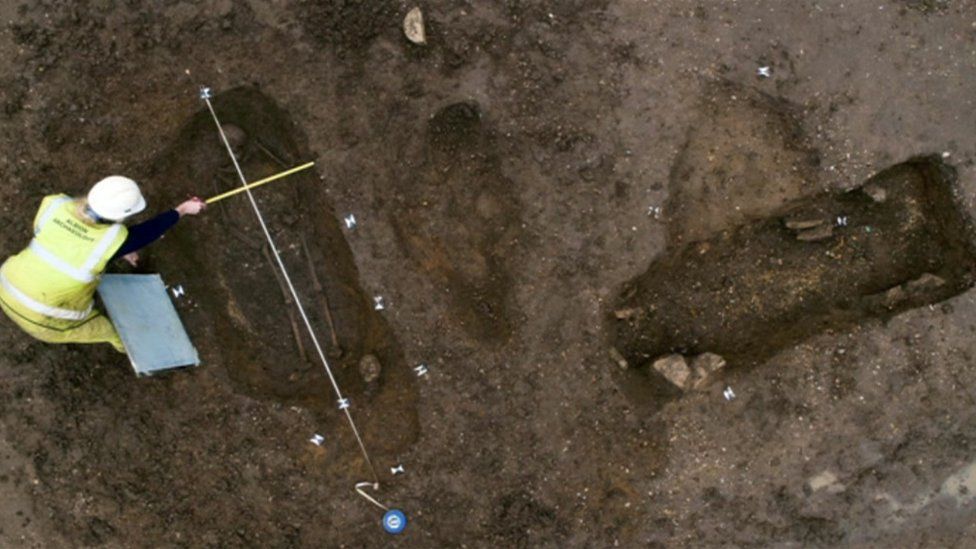
KING'S COLLEGE/DRONESCAPES

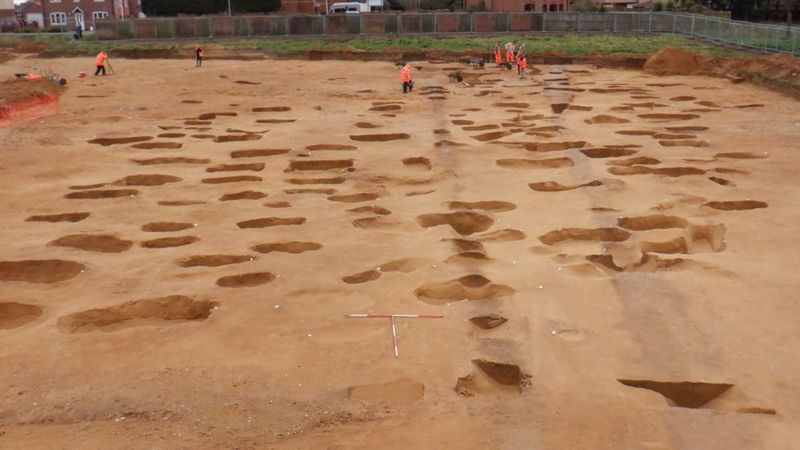
An Anglo-Saxon graveyard with "huge potential" has been unearthed beneath former university student housing.

King's College, Cambridge discovered the extensive cemetery, containing more than 60 graves, after demolishing a group of 1930s buildings.

Evidence of Iron Age structures and Roman earthworks was also identified.

Dr Sam Lucy, from the University of Cambridge, said the discovery of graves spanning different periods was "very unusual and really interesting".

Since the 19th century, archaeologists have believed there was an early Medieval/Anglo-Saxon cemetery in west Cambridge.

Read the rest of this article...

Sunday, 31 January 2021

'Find of the century': medieval hoard of treasures unearthed in Cambridge

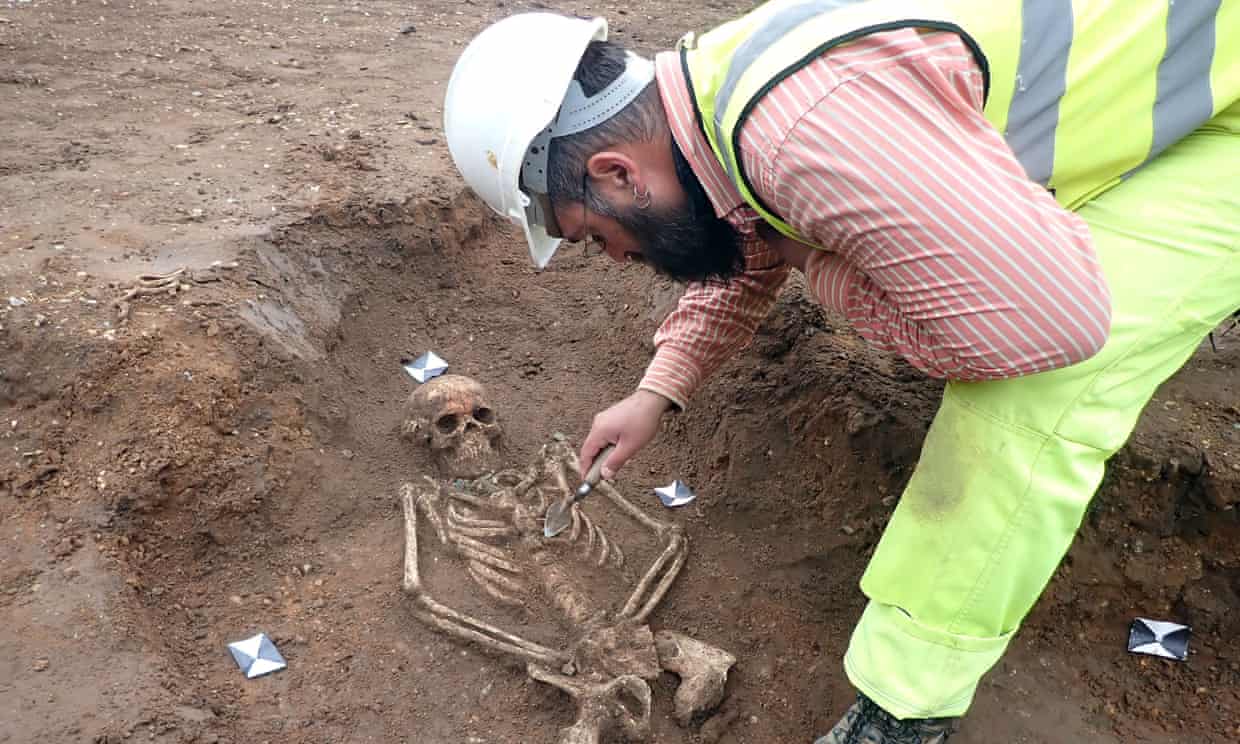
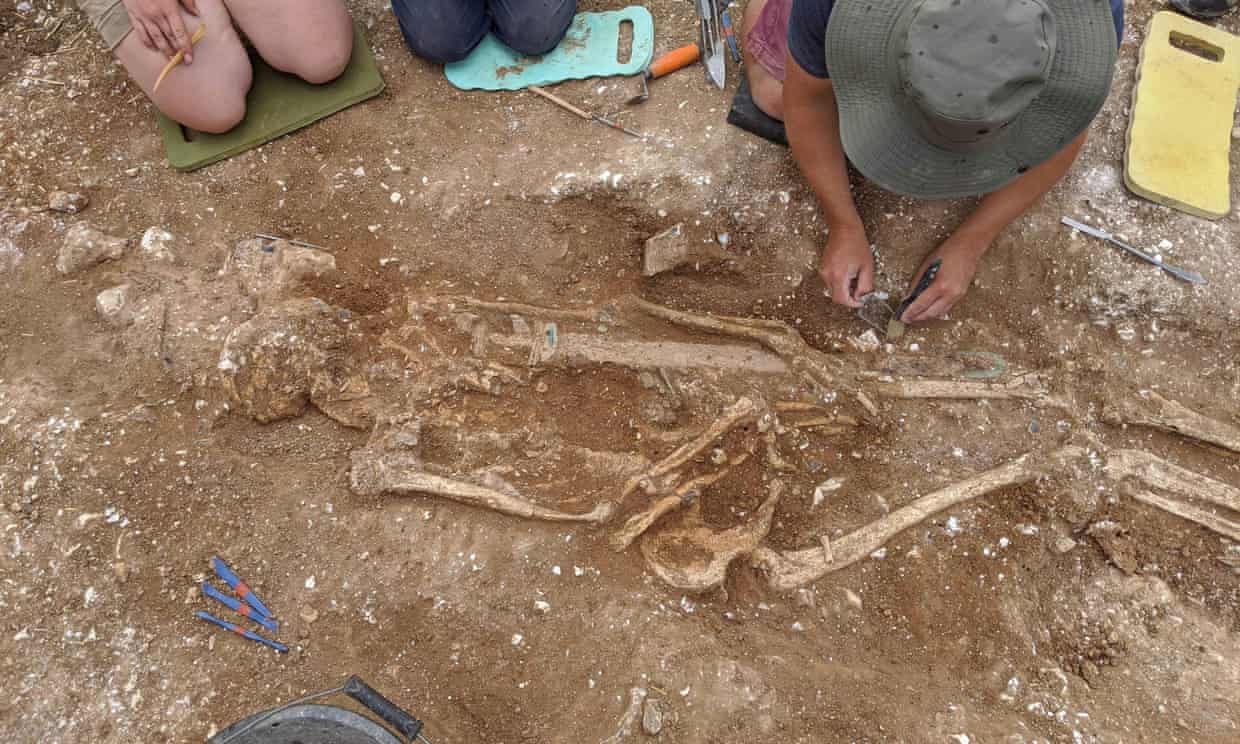
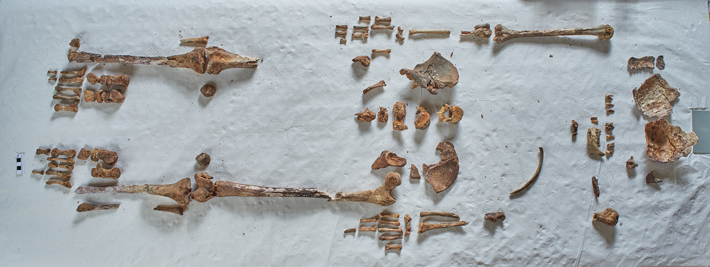
The human remains found at the Cambridge site are remarkably well preserved in the alkaline soil. Photograph: Albion Archaeology 

Graves found under demolished student halls are providing valuable insight into life in a post-Roman settlement

An early medieval graveyard unearthed beneath student accommodation at Cambridge University has been described as “one of the most exciting finds of Anglo-Saxon archaeology since the 19th century”.

King’s College discovered the “extensive” cemetery, containing more than 60 graves, after demolishing a group of 1930s buildings which had recently housed graduates and staff in the west of the city, to make way for more modern halls.

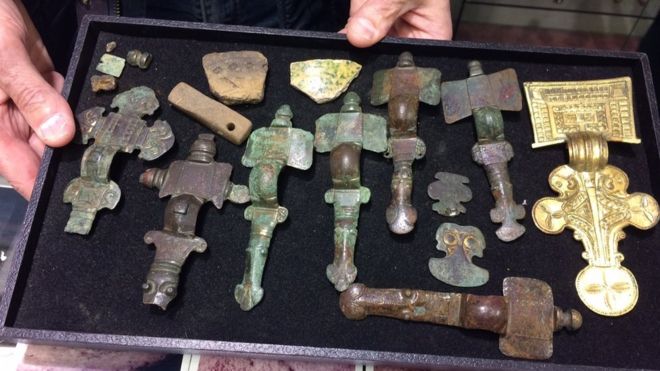
Around 200 items in the graves, including bronze brooches, bead necklaces, swords, short blades, pottery and glass flasks, have been systematically uncovered. Most date from the early Anglo-Saxon period (c400-650 CE), although evidence of iron age structures and Roman earthworks has also been found.

Friday, 29 January 2021

Rare Scraps of Mineralized Anglo-Saxon Textiles Found in England


A fragment of 1,500-year-old cloth is still attached to a metal brooch found at the site.
 (Courtesy of the Museum of London Archaeology)

Last year, two companies developing land near the small village of Overstone in Northamptonshire, England, discovered a pair of subterranean surprises: a trove of 1,500 year-old Anglo-Saxon treasures and remnants of 4,000-year-old Bronze-Age burials and structures.

Barratt and David Wilson Homes had hired archaeologists from the Museum of London Archaeology (MOLA) to excavate the area ahead of construction. The researchers announced their finds earlier this month following an extensive, year-long dig.

Altogether, reports Carly Odell for the Northamptom Chronicle & Echo, the 15-hectare (37-acre) tract of land boasts a rich deposit of artifacts that spans thousands of years. The Anglo-Saxon cemetery is likely the largest of its kind ever discovered in the East Midlands county.

Per the statement, the team unearthed two Anglo-Saxon sites side-by-side: a cemetery with 154 burials and the remains of a settlement made up of 22 structures. (Another 20 Anglo-Saxon buildings were scattered across the area.) Researchers extracted more than 3,000 objects total, from jewelry, including 50 brooches, 15 rings and 2,000 beads, to weapons, such as 40 knives, 25 spears and 15 shield bosses, or conical pieces placed at the center of shields. Other finds included combs carved out of bone and cosmetic kits.

Read the rest of this article...
Astonishing Anglo-Saxon artefact!


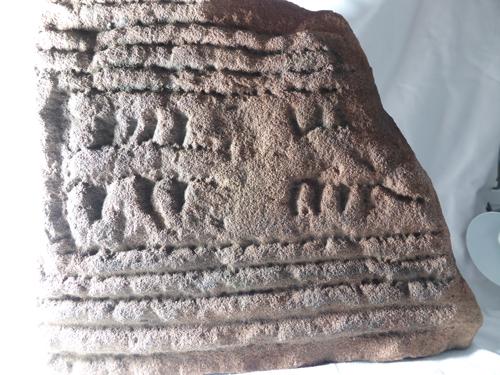
This rare and exciting fragment of Anglo-Saxon sculpture was found on an archaeological excavation at Mark Rake, Bromborough, Wirral in late 2016! The carved sandstone fragment is part of a slab carved between 900 and 1100 AD, and is decorated with incised lines marking out a border around what is probably a cross.

The site where it was found lies in the middle of Bromborough village, just to the north of the parish church which is dedicated to St Barnabas, and until recently the plot of land formed part of the Rectory gardens. The site came to the attention of Museum of Liverpool’s archaeologists when a planning application was made to build houses on the site after it was sold by the church.

Little is known of the origins of villages on the Wirral, but there are hints that many of them have been occupied since at least the Roman period and possibly longer; earlier excavations at Thorstone Drive, Irby and Hilary Breck, Wallasey, had found evidence for Prehistoric, Roman and early medieval buildings and other features and Mark Rake’s location, immediately next door to a church mentioned in the Domesday Survey, suggested that it had the potential for similar finds.

Read the rest of this article...

Wednesday, 27 January 2021

Significant Anglo-Saxon Cemetery And Settlement Found In Overstone, Northamptonshire

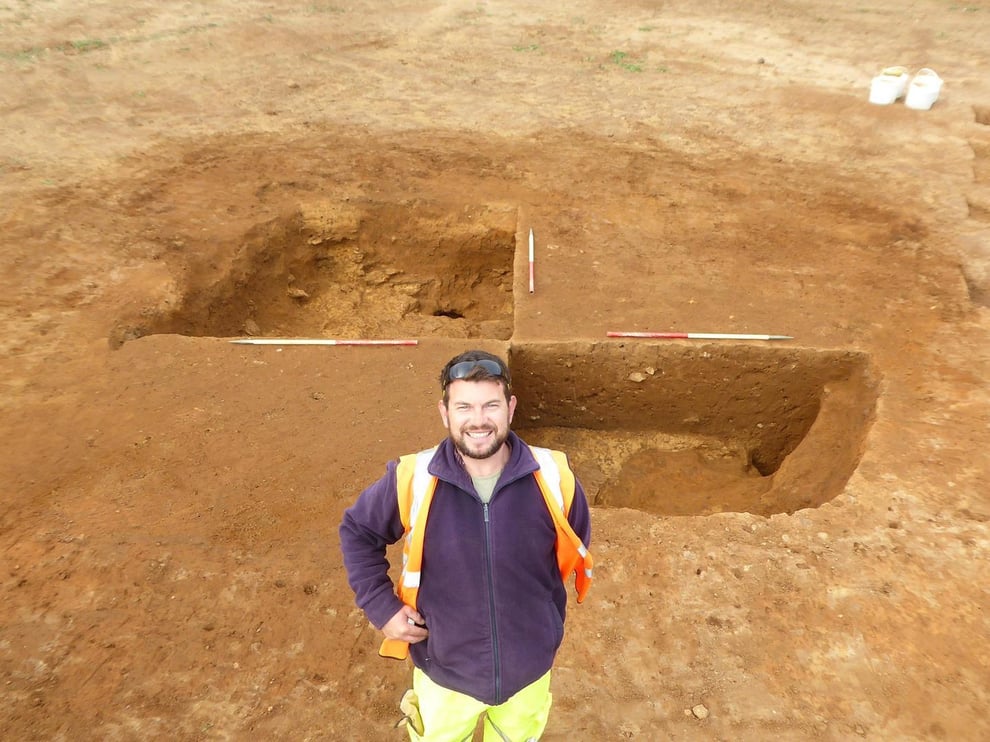
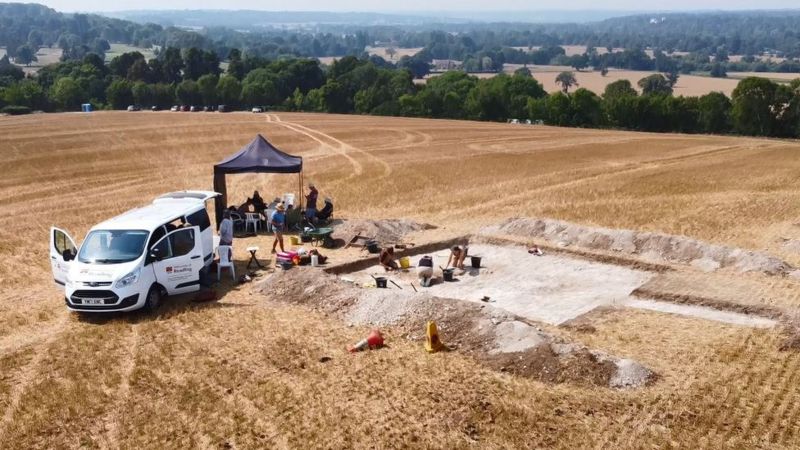
Aerial view of the excavation at Overstone [Credit: MOLA]

A team from the Museum of London Archaeology (MOLA) have excavated the largest Anglo-Saxon cemetery in Northamptonshire at Overstone Gate. Excavations were conducted over the course of 12 months, in preparation for the construction of a housing development.

154 Anglo-Saxon burials were found, containing beautiful grave goods totalling nearly 3000 objects. These included jewellery (roughly 150 brooches, 15 rings, 2000 beads, 75 wrist clasps and 15 chatelaines), weapons (roughly 25 spears, 40 knives and 15 shield bosses), and everyday objects such as cosmetic kits and bone combs. Pieces of textile, which rarely survive in the archaeological record, were found preserved next to metal objects which had caused them to mineralise. All of the finds have now been removed from site for analysis by our specialists.

Read the rest of this article...

Sunday, 17 January 2021

New Insights From Original Domesday Survey Revealed


A new interpretation of the survey behind Domesday Book—the record of conquered England compiled on the orders of William the Conqueror in 1086—has emerged from a major new study of the survey's earliest surviving manuscript.

Research published in the English Historical Review shows historians now believe Domesday was more efficient, complex, and sophisticated than previously thought. The survey's first draft, which covered England south of the River Tees, was made with astonishing speed—within 100 days.

It was then checked and reorganised in three further stages, resulting in the production of new documents, each carefully designed for specific fiscal and political purposes. The iconic Domesday Book was simply one of several outputs from the process.

Lead researcher, Dr. Stephen Baxter, Associate Professor of Medieval History at the University of Oxford, said: "Domesday Book is at once one of medieval England's best known and most enigmatic documents. The reasons for—and processes behind—its creation have been the subject of debate among historians for centuries. This new research, based on the earliest surviving Domesday manuscript, shows the survey was compiled remarkably quickly and then used like a modern database, where data is entered in one format and can be extracted in other formats for specific purposes."

Read the rest of this article...

Thursday, 14 January 2021

Grave goods including weapons found at large Anglo-Saxon cemetery uncovered in Northamptonshire


Archaeologists uncovered the site during pre-construction planning requirements.

More than 150 burials were found and many contained grave goods including weapons, beads and brooches

A burial site that could be up to 4,000 years old has been found on housing development land in Northamptonshire.

Archaeologists have called the site in Overstone ‘by far the biggest’ Anglo-Saxon cemetery ever found in the county.

The site was excavated as part of pre-construction planning requirements at Overstone Farm where Barratt and David Wilson homes intend to build two to five bedroom homes, a school and amenities, as part of a new housing development.

Monday, 21 December 2020

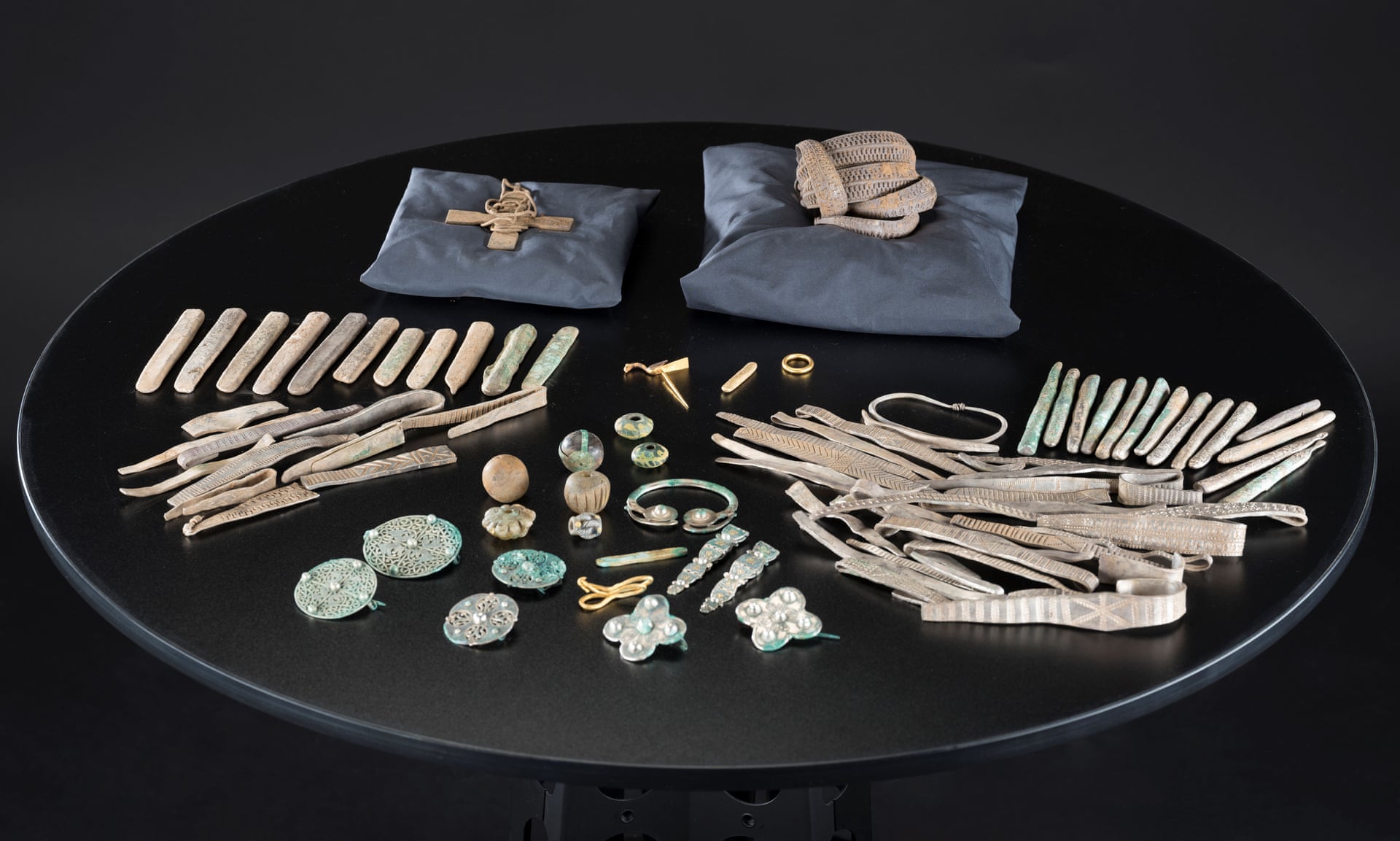
£1m grant to investigate secrets of Viking-age Galloway hoard uncovered by metal detectorist


pieces from the 10th-century treasure trove, known as the Galloway Hoard, which was found by a metal detectorist in a field in Dumfries and Galloway in 2014 and acquired by NMS in 2017, will go on display in an exhibition next year.

National Museums Scotland (NMS) will carry out the three-year project, entitled “Unwrapping the Galloway Hoard”, in partnership with the University of Glasgow to examine the objects in detail.

The 10th-century treasure trove, which was found by a metal detectorist in a field in Dumfries and Galloway in 2014 and acquired by NMS in 2017, will go on display in an exhibition next year.

The research will involve precise dating of the items and, it is hoped, identification of their places of origin, which are thought to range from Ireland to the Byzantine empire and perhaps beyond.

Read the rest of this article...

Researchers win £1m grant to unlock secrets of Viking-era treasure trove


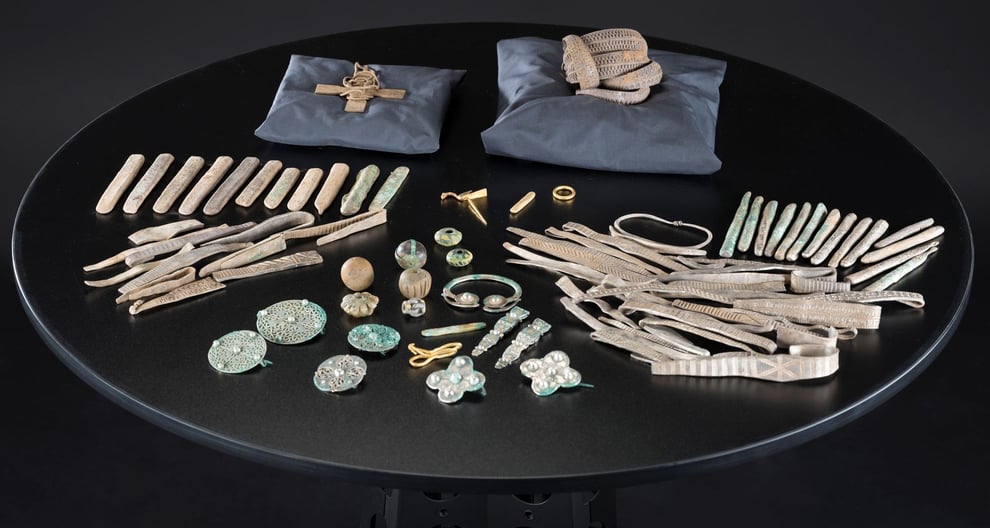
The Galloway Hoard has been acquired by National Museums Scotland.
Photograph: National Museums Scotland/PA 

Researchers in Scotland hope to unlock the secrets of a stunning Viking-age hoard after a receiving a £1m grant to examine the provenance of the 10th century haul that lay undisturbed for a thousand years before being unearthed by a metal detectorist.

The incredible discovery of the Galloway Hoard, comprising more than 100 objects including silver jewellery and ingots, was made in September 2014 in a field in Dumfries and Galloway. It has since been acquired by National Museums Scotland (NMS).

NMS will carry out a three-year project, “Unwrapping the Galloway Hoard”, in partnership with the University of Glasgow, to examine in detail the objects, due to go on display in an exhibition next year.


Read the rest of this article...

Saturday, 24 October 2020

CBA Festival of Archaeology

 The Council of British Archaeology’s Festival of Archaeology runs from 24 October to 1 November.  The situation with the Corona Virus means that many of the events will be digital, although there will be a number of live events. Please use the search facility on their webpage to see the various events that are offered.


You can find their website here…

Please note that EMAS archaeological Society has offered a quiz on little known archaeological sites in South East England.

You can find a link to the quiz on the EMAS home page here…

Test your knowledge and see how much you know about the archaeology of the area!

Tuesday, 13 October 2020

Anglo-Saxon girl had her nose and lips cut off as punishment, shows skull


Skull of young Anglo-Saxon girl, front view with cuts and back view
with unfused sutures [Credit: Garrard Cole, Antiquity]

An Anglo-Saxon teenage girl appears to have had her nose and lips cut off — and possibly her head scalped as well — analysis of an old skull has revealed.

Unearthed in Oakridge, Hampshire, the remains have been radiocarbon dated to 776–899 AD — predating written accounts of this gruesome form of punishment.


Although it is not known exactly why the poor young woman was subject to the horrific facial mutilation, it was once routinely meted out to female offenders.

The disfigurement was given to adulteresses, slaves who stole and criminals guilty of more severe acts, the researchers reported. 

Tuesday, 6 October 2020

Marlow warlord's remains part of 'key archaeological site'


The burial site is believed to date from the 6th century AD
PETE BRYANT

The discovery of a warrior warlord's burial site could change historians' understanding of southern Anglo-Saxon Britain, according to archaeologists.

The 6ft "Marlow Warlord" was discovered in August close to the Buckinghamshire town.

An archaeological dig of the area took place after metal detectorists discovered two bronze bowls.

Dr Gabor Thomas said the find provided "new insights" into life after the collapse of Roman Britain.

The specialist in early medieval archaeology at the University of Reading said the burial suggested "people living in this region may have been more important than historians previously suspected".

Archaeologists unearth remains believed to be of Anglo-Saxon warlord


The remains of the Marlow Warlord are unearthed. Photograph: University of Reading

The final resting place of what appears to be an Anglo-Saxon warrior has been unearthed in a field in Berkshire, in a discovery archaeologists say sheds fresh light on the rise and fall of local tribes.

Buried with an array of weapons including spears and a sword with its scabbard, the skeleton of a man dating from the sixth century was found in August – two years after metal detectorists discovered bronze bowls at the site and alerted experts.

Dr Gabor Thomas, a specialist in early medieval archaeology at the University of Reading who worked on the subsequent excavation, said there had been much debate about whether individuals buried with such goods were warriors or were buried with weapons as a symbolic gesture.

Tuesday, 22 September 2020

Oulton burial site: Sutton Hoo-era Anglo-Saxon cemetery discovered

 The Anglo-Saxon cemetery is believed to date back to the same period as the famous Sutton Hoo burial site near Woodbridge

SUFFOLK COUNTY COUNCIL

A "nationally significant" Anglo-Saxon cemetery with 200 graves dating back to the 7th Century has been revealed.

The graves were uncovered in Oulton, near Lowestoft in Suffolk, ahead of construction of a housing development.

The burial ground contained the remains of men, women and children, as well as artefacts including brooches, small iron knives and silver pennies.

Suffolk's Archaeological Service said studies would help establish the graveyard's links to other local sites.

A spokesman said the site "lies within the Kingdom of the East Angles, made famous by the royal burial ground at nearby Sutton Hoo".

Sutton Hoo, discovered in 1939, included two cemeteries from the 6th to 7th centuries and a ship burial full of treasures believed to be the final resting place of King Raedwald.

Read the rest of this article...

Thursday, 18 June 2020

ID'ing England's First Nun

(Courtesy Finding Eanswythe) 
Probable remains of Saint Eanswythe, England

Many people in the port town of Folkestone in southeastern England still revere Saint Eanswythe, a seventh-century Anglo-Saxon princess who helped found Folkestone Priory, the first nunnery in England. Her remains were thought to have been interred at the priory until the 1530s, but went missing after Henry VIII dissolved the country’s monasteries. In 1885, a lead container with human bones was discovered concealed in a wall near the priory’s altar. It was long assumed the relics were Saint Eanswythe’s, and that they had been hidden to protect them from the Tudor king’s machinations. Now, work on the reliquary led by Canterbury Archaeological Trust archaeologist Andrew Richardson has provided new evidence that the remains are in fact those of the missing holy woman. 

The team’s study shows that the container dates to around the eighth century, and that the remains belonged to a young woman of about 20 years old who lived in the mid-seventh century. Says Richardson, “The strong probability is that this young person, concealed in a prestigious location within a church known to have housed her remains, is indeed Eanswythe.”

Read the rest of this article...

The Beowulf Manuscript – Nowell Codex

The Only Surviving Manuscript of Beowulf

Beowulf is an Old English epic poem that survives in a single copy in the manuscript known as the Nowell Codex. It has no title in the original document but has become known by the name of the story’s hero.

The poem is known only from a single manuscript, which is estimated to date from around 975–1025.

The manuscript dates either to the reign of Æthelred the Unready or to the beginning of the reign of Cnut the Great from 1016.

The Beowulf manuscript is known as the Nowell Codex, gaining its name from the 16th-century owner and scholar Laurence Nowell.

The earliest surviving reference to the Nowell Codex was made about 1650, and the prior ownership of the codex before Nowell remains a mystery.

Read the rest of this article...

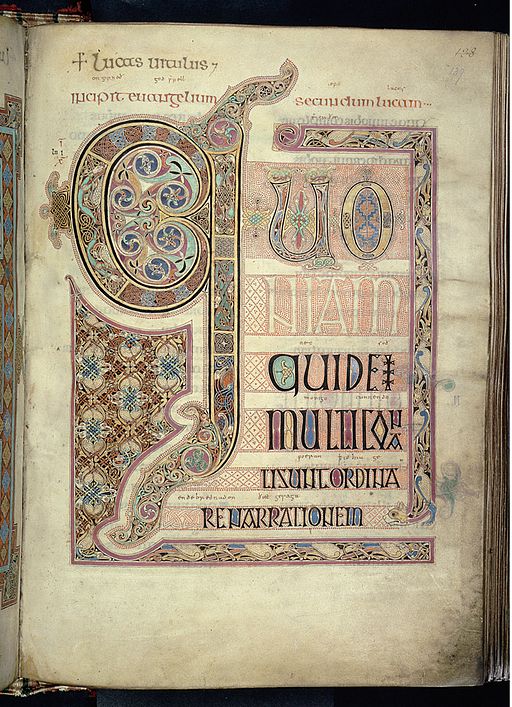
Lindisfarne Gospels


The Lindisfarne Gospels is an illuminated manuscript produced about 715 – 720 in the monastery at Lindisfarne, off the coast of Northumberland. It is an illustrated Latin copy of the Gospels of Matthew, Mark, Luke, and John,

The manuscript is in the unique style of Hiberno-Saxon combining Mediterranean, Anglo-Saxon and Celtic elements.

The Lindisfarne Gospels are presumed to be the work of a monk named Eadfrith, who became Bishop of Lindisfarne in 698. Some parts of the manuscript were left unfinished, indicating that Eadfrith was still working on it at his time of death.

Read the rest of this article...

Sunday, 24 May 2020

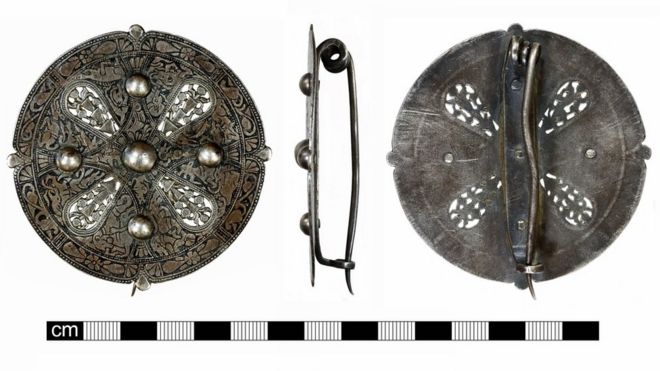
Norfolk discovery of 1,100-year-old brooch 'will remain a mystery'

Experts at the British Museum say the brooch is of "national significance"
Image copyright NORFOLK COUNTY COUNCIL

The origins of a 1,100-year-old brooch found in a lorry-load of soil may be "a mystery" that is never solved, say archaeologists.

The late 9th Century silver disc was discovered in a field in Great Dunham, Norfolk, which had recently been landscaped.

It is not known where the soil came from, but experts say the find is similar to the nearby Pentney Hoard.

The British Museum said the discovery was of "national importance".

An inquest - the process by which the find may be officially declared treasure - has been opened in Norwich and will conclude on 9 June.

Read the rest of this article...

Thursday, 7 May 2020

Cleethorpes teacher's Anglo-Saxon treasures sell for £30k

Hundreds of objects sold as part of the collection include spear heads, brooches and beads
HANSONS

Anglo-Saxon treasure unearthed by a history teacher in a field has sold for £30,000 at auction.

Gordon Taylor discovered the artefacts, which date back to 450 AD, in 1962 after finding a piece of bone in Irby-on-Humber, North East Lincolnshire.

It led to a 17-year excavation, in which items including a 1,000-year-old skull, jewellery, scissors and a spear head were also uncovered.

The 250-strong collection is believed to have been sold to a museum.

Mr Taylor, from Cleethorpes, died three years ago aged 88. His son Geoff said the family were "absolutely delighted" by the sale.

"I watched the sale live. I just called my mum and she is over the moon," he said.

He said he hoped the artefacts would be put "on public view".

Read the rest of this article...

Sunday, 3 May 2020

Peeling back the layers of a Saxon tower in Stowe Nine Churches, Northamptonshire


Once the situation allows, our Northampton historic building team are looking forward to being able to record and monitor the conservation of a church tower at St Michael’s, a Grade I listed rural parish church with potential Saxon origins in Stowe Nine Churches, Northamptonshire. In this blog, Historic Building Officer Lauren Wilson explains what she hopes to learn…

St Michael’s Church has stood on its perch overlooking the Grand Union Canal for over a thousand years, however the external render of the tower has been causing damage to its structure, so it is being removed so that conservation works can take place before the render is then reapplied using a more sensitive material. This gives us a wonderful opportunity to inspect the underlying fabric of the tower.

There are several questions that we are hoping to answer: How much of the upper stages of the tower retain their Saxon stonework? What is the relationship between the architectural elements like the iron strapwork, the phases of render, and the window apertures?

Read the rest of this article...