The Anglo-Saxon Archaeology Blog is concerned with news reports featuring Anglo-Saxon period archaeology. If you wish to see news reports for general European archaeology, please go to The Archaeology of Europe Weblog.
Friday, 18 December 2015
Staffordshire Hoard Newsletter: Conservation Update
The conservation team have been busy with reconstruction of the fragments of silver and silver gilt objects recently. Alongside the conservation work the team have been busy presenting the hoard project at conferences, including the European Archaeological Association conference in Glasgow and Monumental Treasures conference in Helsinki.
Read the rest of this article...
Monday, 14 December 2015
Viking hoard found in field sheds light on England's origins
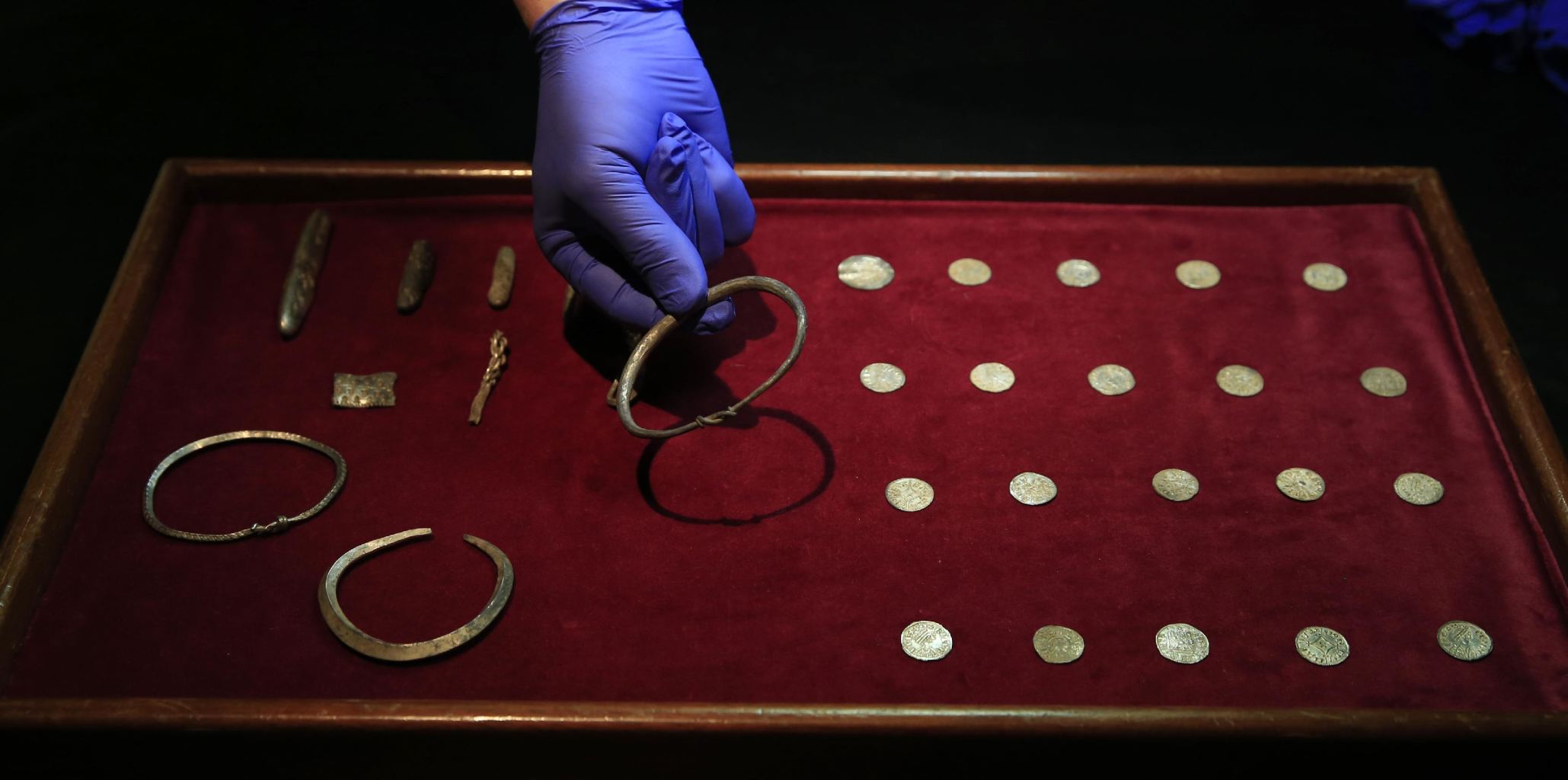
A trove of Viking jewelry and Saxon coins unearthed by an amateur treasure-hunter in a farmer's field may help rescue an English king from obscurity.
The Watlington Hoard, a collection of silver bands, ingots and 186 coins unveiled at the British Museum Thursday, dates from a tumultuous period. The coins were minted during the reign of Alfred the Great, ruler of the Anglo-Saxon kingdom of Wessex, who battled a "great heathen army" of Viking invaders during the 9th century.
By coincidence, discovery of the hoard coincides with the broadcast of "The Last Kingdom," a big-budget BBC drama series that has boosted popular interest in the conflict between Alfred and the Vikings.
Alfred is renowned as the ruler whose victories helped create a unified England, but some of the coins in the hoard also bear the name of the far more obscure King Ceolwulf II of Mercia, a neighboring kingdom to Wessex.
"Poor Ceolwulf gets a very bad press in Anglo Saxon history," said museum coins curator Gareth Williams. What little is known of him was written at Alfred's court and paints Ceolwulf as "a puppet of the Vikings."
Read the rest of this article...
Viking hoard discovery reveals little-known king 'airbrushed from history'
A hoard of Viking coins could change our understanding of English history, after showing how Alfred the Great 'airbrushed' out a rival king
A rare coin showing King Alfred ‘the Great’ of Wessex (r.871-99) and King Ceolwulf II of Mercia (874-79)
A Viking hoard discovered by an amateur metal detectorist could prompt the re-writing of English history, after experts claimed it shows how Alfred the Great “airbrushed” a rival king from history.
Ceolwulf II of Mercia is barely mentioned in contemporary records and largely forgotten by history, only briefly described in the Anglo-Saxon Chronicle as an “unwise King’s thane”.
But as of today, his reputation might be rescued after a haul of coins dug up after more than 1,000 years suggested he in fact had a powerful alliance with Alfred, ruling their kingdoms as equals.
Tuesday, 24 November 2015
ARCHAEOLOGISTS REVISIT ENGLAND’S LEGENDARY GLASTONBURY ABBEY
The real history of Glastonbury Abbey, renowned for its links to the legendary King Arthur, has finally been uncovered thanks to ground-breaking new research from the University of Reading.
The four-year project reassessed and reinterpreted all known archaeological records from excavations at the Abbey between 1904 and 1979, none of which have ever been published. Analysis revealed that some of the Abbey’s best known archaeological 'facts’ are themselves myths - many of these perpetuated by excavators influenced by the fabled Abbey’s legends.
Research revealed that the site was occupied 200 years earlier than previously estimated - fragments of ceramic wine jars imported from the Mediterranean evidence of a ‘Dark Age’ settlement. The analysis also showed how the medieval monks spin-doctored the Abbey’s mythical links to make Glastonbury one of the richest monasteries in the country.
Glastonbury Abbey in Somerset holds a special place in popular culture. It was renowned in the early middle ages as the reputed burial place of the legendary King Arthur and the site of the earliest Church in Britain, thought to have been founded by Joseph of Arimathea.
The project, conducted with partners Trustees of Glastonbury Abbey and funded by the Arts and Humanities Research Council, involved a team of 31 specialists.
Read the rest of this article...
Thursday, 12 November 2015
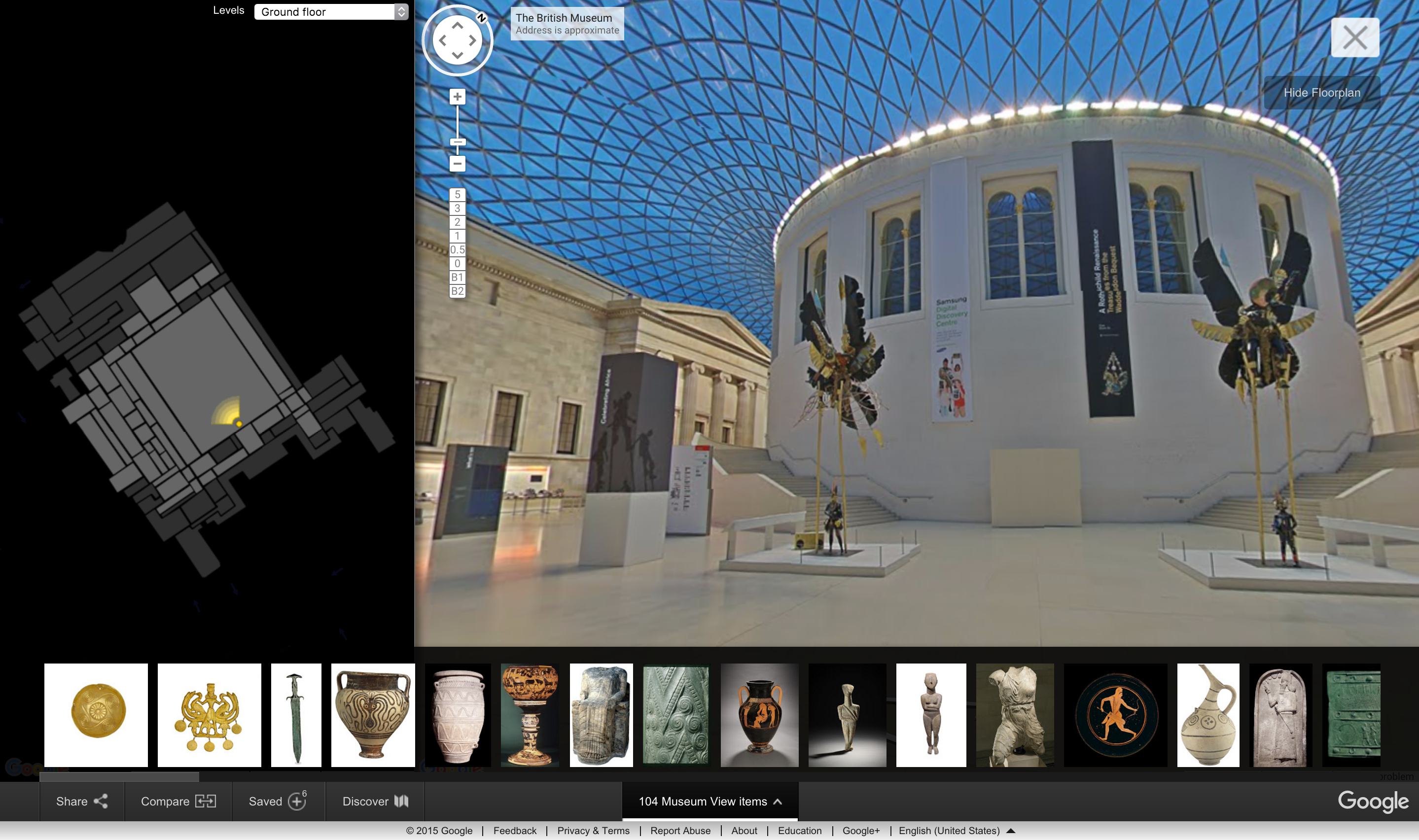
Explore 4,500 British Museum artifacts with Google's help
The British Museum in London holds an array of beautiful and historically significant artifacts including the Rosetta Stone, which helped historians to understand the ancient hieroglyphics used in Egypt. Today, the organisation is teaming up with Google to bring its various collections online as part of the Google Cultural Institute. The search giant has been developing this resource for years by continually visiting and archiving exhibits around the world. With the British Museum, an extra 4,500 objects and artworks are being added to its collection, complete with detailed photos and descriptions.
The most important addition is arguably the Admonitions Scroll, a Chinese text which dates back to the 6th-century. The piece is incredibly fragile, so it's only visible in the museum for a few months each year. Through the Cultural Institute, you can take a peek whenever you like -- and because it's been captured at "gigapixel" resolution you can zoom in to see some extraordinary details. All of the objects are searchable on Google's site, along with a couple of curated collections about ancient Egypt and Celtic life in the British Iron Age.
Read the rest of this article...
Wednesday, 11 November 2015
Detectorist finds hoard of 5,000 Anglo-Saxon coins
A hoard of more than Anglo Saxon 5,000 coins have been unearthed, including what may be a unique penny. The discovery, near Lenborough, Buckinghamshire is said to be the biggest hoard of coins in modern times.
A hoard of more than Anglo Saxon 5,000 coins have been unearthed, including what may be a unique coin. The 5,248 coins were found by Paul Coleman on December 21 last year [Credit: Kerry Davies/INS News Agency Ltd]
It includes a uniquely-stamped coin which may be the results of a mix-up at the mint, more than 1,000 years ago. No valuation has officially been placed on the coins, which have formerly been declared as treasure trove, but some experts believe they could be worth more than £1 million.
The 5,248 coins were found by metal detector enthusiast Paul Coleman on December 21 last year. He almost decided not to dig the site when his metal detector beeped, believing he had come across a hidden manhole cover.
Read the rest of this article...
Wednesday, 28 October 2015
UK buyer sought to keep Anglo-Saxon brooch in country
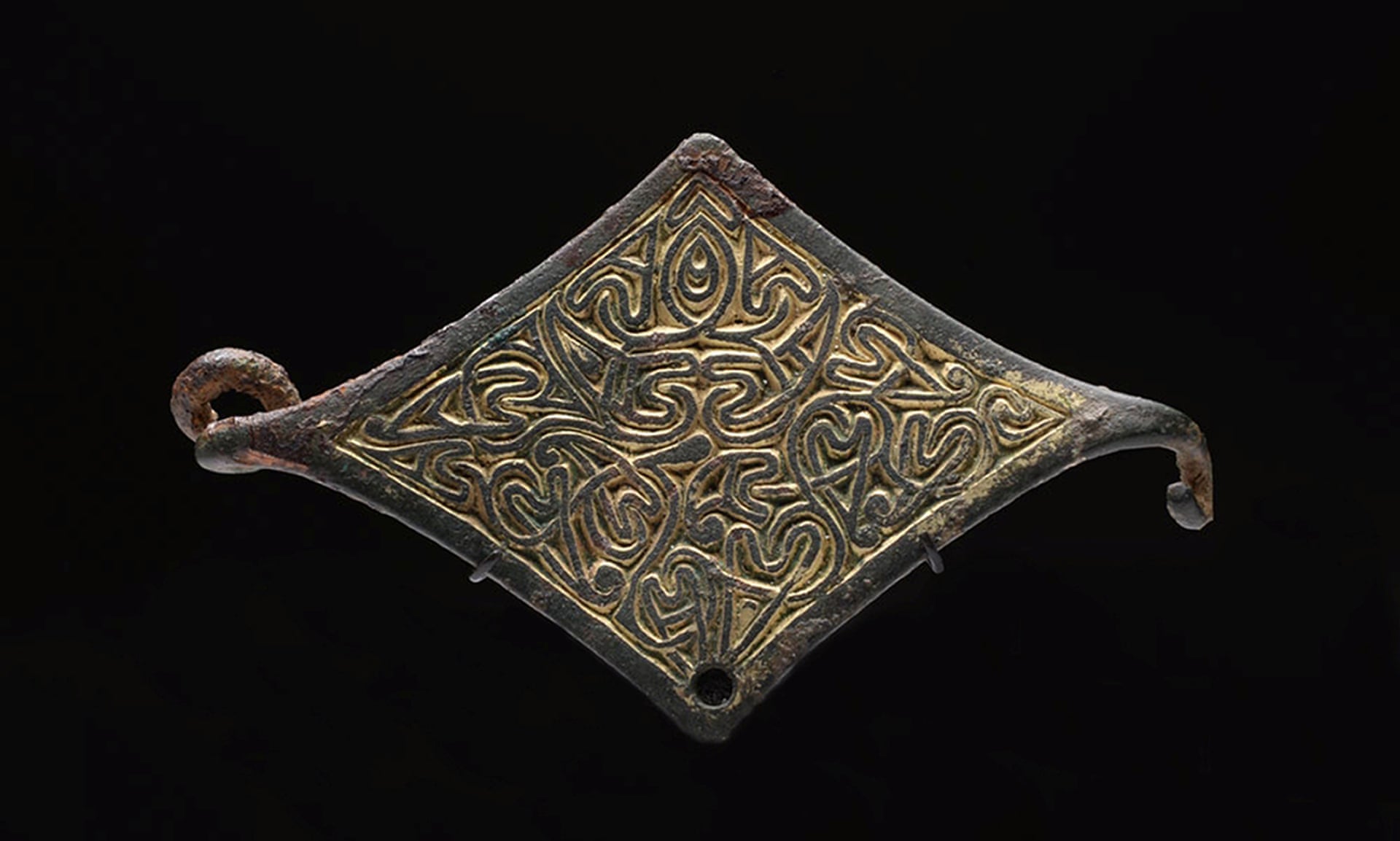
An elaborate Anglo-Saxon brooch that is more than 1,000 years old may be exported if a UK buyer is not found who will pay at least £8,000 for it.
The gilt bronze brooch, from the late 8th century, is one of just 12 such ornaments in existence, and it stands out from the rest for the skill and creativity employed in the creation of its unique complex leaf pattern, which could represent the Christian tree of life.
An illustration dating from the same period of the Virgin Mary in the Book of Kells shows her wearing a similar brooch, suggesting they were worn by high-status women.
Experts said the brooch is of outstanding significance for the study of Anglo-Saxon art and material culture, but it could be exported unless a UK buyer matches the £8,460 asking price.
Read the rest of this article...
Friday, 23 October 2015
76 skeletons discovered at Saxon Woolwich
Saxon remains have been found by archaeologists excavating Berkeley Homes development site on the Royal Arsenal Riverside site.
Saxon burial being excavated [Credit: South London Press]
Oxford Archaeology have uncovered evidence of nearly 3000 years of human activity on the west side of the site which in ancient times would have been a gravel peninsula surrounded by marshlands.
Surprisingly a burial site with 76 skeletons have been found which have been radio carbon dated to the late 7th or early 8th century meaning they are former inhabitants of Saxon Woolwich.
Project manager David Score said ‘It is amazing to find such a large number of relatively well preserved skeletons, despite all the later building on the site over the years. They seem to represent a mixed population with males and females, children and adults present. Only one possible knife was recorded as a probable grave deposit so it seems that the burials do represent an early Christian tradition’.
Read the rest of this article...
Monday, 12 October 2015
EMAS Field Trip: Four Anglo-Saxon Churches in Hampshire
EMAS Field Trip to Headborne Worthy; Tichborne; Corhamton
and Boarhunt Anglo-Saxon Churches
Saturday, 7 November 2015
Read the rest of this article...You can find more EMAS events here...
Archaeologists to uncover secrets of Viking fortress
When archaeologists found the first Viking Age fortress in Denmark for 60 years last September, it was hailed as a fantastic archaeological discovery.
Now the time has come for the archaeologists to unearth the hidden secrets and legacy of the fortress, located near Køge just south of Copenhagen. A 20 million kroner grant from the AP Møller Fund and 4.5 million kroner from Køge Municipality has helped make that possible.
“With the grant, the Danish Castle Centre – a division of Museum Southeast Denmark and Aarhus University – has worked out a unique research project seeking to explore the secrets Borgring is hiding beneath Danish soil,” the Danish Castle Centre said.
“With the use of modern archaeological methods the scientists and archaeologists will investigate how the fortresses were used, how they were organised, how quickly they were built, their age and what environment, landscape and geography they were a part of.”
Read the rest of this article...
Monday, 14 September 2015
Hunt for Anglo-Saxon abbey wall at Peterborough Cathedral
Archaeologists surveying a cathedral's precincts are hoping to uncover the location of its walled Anglo-Saxon predecessor.
Ground penetrating radar is being used to survey the cathedral grounds [Credit: Peterborough Cathedral] Peterborough Cathedral was built by the Normans after the 10th Century abbey burned to the ground in 1116.
Cathedral archaeologist Jackie Hall said the aim was to learn more about the Anglo-Saxon monastery because "we don't know enough about that".
It is more than 30 years since a dig discovered a small area of wall.
Dr Hall said: "They found the bottom of the wall, which was built out of bright yellow mortar and stone.
Read the rest of this article...
Sunday, 2 August 2015
New research on the causes of the Viking Age
The Viking hit-and-run raids on monastic communities such as Lindisfarne and Iona were the most infamous result of burgeoning Scandinavian maritime prowess in the closing years of the Eighth Century.
The Vale of York Cup - a Christian vessel from northern mainland Europe that was probably held by Scandinavians for some time after its capture, before finishing its life as the receptacle for a large silver hoard buried in Yorkshire [Credit : York Museums Trust]
These skirmishes led to more expansive military campaigns, settlement, and ultimately conquest of large swathes of the British Isles. But Dr Steve Ashby, of the Department of Archaeology at the University of York, wanted to explore the social justifications for this spike in aggressive activity.
Previous research has considered environmental, demographic, technological and political drivers, as well as the palpable lure of silver and slave and why these forms of wealth became important at this stage.
Read the rest of this article...
Tuesday, 28 July 2015
New research on the causes of the Viking Age
The Viking hit-and-run raids on monastic communities such as Lindisfarne and Iona were the most infamous result of burgeoning Scandinavian maritime prowess in the closing years of the Eighth Century.
These skirmishes led to more expansive military campaigns, settlement, and ultimately conquest of large swathes of the British Isles. But Dr Steve Ashby, of the Department of Archaeology at the University of York, wanted to explore the social justifications for this spike in aggressive activity.
Previous research has considered environmental, demographic, technological and political drivers, as well as the palpable lure of silver and slave and why these forms of wealth became important at this stage.
Read the rest of this article...
Wednesday, 8 July 2015
You(r) Archaeology – portraying the past
“You(r) Archaeology – portraying the past” - A European competition to express your view.
What is archaeology? An adventure? A pain in the neck? The appeal of the past, the magic of marvellous sites, the boredom of a dusty museum? Probably all of these together, and still more.
Up until July 31st 2015, all European citizens can answer the question and tell us about their idea of archaeology by entering a drawing, painting, photo or video in the European competition “You(r) Archaeology”.
Further details...
Monday, 29 June 2015
Dundee experts recreate face of Saxon man at Lincoln Castle
Facial reconstruction experts at the University of Dundee have recreated the face of a Saxon man whose skeleton was discovered on the site of an old church at Lincoln Castle.
On Monday 8th June, the new-look castle will be officially opened by HRH The Princess Royal. On that day, a new exhibition will be revealed in the Victorian Prison, sharing some of the archaeological finds unearthed during the Lincoln Castle Revealed project.
As part of the exhibition, experts at the University of Dundee have recreated the face of an Anglo Scandinavian man whose skeleton was discovered on the site of an old church within the castle grounds. The skeleton was one of ten sets of remains discovered.
Read the rest of this article...
Tuesday, 16 June 2015
Hunt for Viking DNA among Normandy residents riles anti-racism activists
British scientists searching for evidence of Norse colonisation in the communities of the Cotentin peninsula warn of ‘sensitivities’ over the issue
British researchers on Monday began collecting the DNA of residents from Normandy in northern France in search of Viking heritage, but the project has raised concerns amongst some local anti-racism activists.
Around a hundred volunteers from the Cotentin peninsula area are giving DNA samples to academics at the University of Leicester, who are trying to find descendants of the Vikings who invaded what is now Normandy in the 9th century.
The aim is to learn more about “the intensity of the Scandinavian colonisation” in the 9th and 10th centuries in the Cotentin Peninsula, said Richard Jones, a senior history lecturer at the University of Leicester.
Read the rest of this article...
EMAS Field Trip to Worth, Arlington, Bishopstone, Sompting and Poling
Field Trip to Worth, Arlington, Bishopstone, Sompting and Poling
Guide: David Beard MA, FSA
11 July 2015
Pick up 8:00 am at London Embankment
A visit to five Anglo-Saxon Churches.
Thursday, 28 May 2015
Secrets of Staffordshire Hoard Revealed
- Hundreds of fragments grouped together to reveal remains of incredibly rare high status helmet
- Unique form of sword pommel also uncovered
- Historic England gives £400,000 towards research but £120,000 still needed
Ground breaking research and conservation of the Staffordshire Hoard has uncovered two internationally important objects that link us to an age of warrior splendour, and further our knowledge of seventh century Anglo-Saxon England.
Historic England, has given £400,000 to help reveal the secrets of the Staffordshire Hoard
and increase public understanding of this unique archaeological treasure. The research will culminate in an online catalogue, launched in 2017. The following year will see a major publication exploring the Hoard in more depth, the objects’ meanings and how they relate to each other. The owners of the Hoard, Birmingham and Stoke-on-Trent City Councils, and Birmingham Museums Trust and the Potteries Museum & Art Gallery who care for it on their behalf, have also contributed towards the research.
Read the rest of this article...
Staffordshire Hoard sword and helmet reconstructed
Thousands of metal fragments from the Staffordshire Hoard have been reconstructed into two "significant" new 7th Century objects.
Front view of the sword pommel reconstructed from 26 fragments found in the Staffordshire Hoard [Credit: Birmingham Museums Trust]
Researchers have pieced together parts of a silver helmet and a previously unseen form of sword pommel.
The hoard, which is valued at £3.2m, was found in a field near Burntwood, Staffordshire in July 2009.
Both items have been put on display at Birmingham's Museum and Art Gallery from Tuesday.
Tuesday, 26 May 2015
Archaeological find at Norton Bridge turns out to be from Saxon period
RCHAEOLOGISTS have discovered a wooden butter churn lid unearthed at Norton Bridge is from the Saxon period following scientific tests.
Evidence of prehistoric activity was uncovered in the same area of the site and archaeologists believed the butter churn could be from the same period.
But radiocarbon tests have revealed the lid of the butter churn dates from the early medieval period when the area was part of the Mercian kingdom.
The tests have put a fragment of wood found with the lid as dating between AD715-890, so the lid is from the same period as the Staffordshire Hoard.
Read the rest of this article...
Subscribe to:
Posts (Atom)