Monday, 25 February 2013

How a distaste for 'pagan food' first put the British off horsemeat


The paper does not attempt to explain how the fashion for eating horsemeat re-emerged in other European countries, notably France Photo: Alamy


A new study of the eating habits of the Anglo Saxons suggests that they may have developed a strong distaste for horsemeat because they saw it as a “pagan” food.
The findings, published in the Oxford Journal of Archaeology, could help explain the level of revulsion at the recent revelations that consumers have been eating horsemeat uwittingly.
Evidence from animal bones found at settlement sites across England shows that horses appear to have been eaten on special occasions in the early Anglo Saxon period.
But as Christianity was gradually reintroduced to Britain between the Sixth and Eighth Centuries the custom became increasingly rare.

Read the rest of this article...

Monday, 18 February 2013

Mick Aston Interview


Mick Aston, formerly of television’s Time Team, answers questions submitted by Oxbow Books and David Brown Book Company customers. Candid, witty and refreshingly honest, Mick offers his personal thoughts on the current state of archaeological research in Britain, the relationship between archaeologists and metal detectorists and much more. He provides fascinating insights into his research project in Shapwick, Somerset and offers advice for others hoping to embark on similar projects in the future.

Watch the video...

ARCHI The Archaeological Sites Index


ARCHI, the online searchable archaeological database, has added a new feature that allows users to add sites to their world-wide database.

The online form is easy to use and should prove to be an extremely useful addition to this site.

You can find the online form at:

http://www.digital-documents.co.uk/archi/archi_share.html

Sunday, 17 February 2013

Archaeology Summer Courses at Oxford


The Oxford Experience is offering a number of archaeology courses this summer.

Each course lasts for one week and participants stay in the 16th century college of Christ Church.

The courses offered are:

Cathedrals of Britain by James Bond
An Introduction to Archaeology by David Beard
The Black Death by Trevor Rowley (course full)
Bishop Odo and the Bayeux Tapestry by Trevor Rowley
Colleges of Oxford by Julian Munby
The Architecture and Archaeology of Medieval Churches by David Beard (course full)
Cotswold Towns by Trevor Rowley
Treasures of the British Museum by Michael Duigan (course full)
Churches of England by Kate Tiller
Treasures of the Ashmolean Museum by Gail Bent
The Age of Stonehenge by Scott McCracken
The World of the Vikings by David Beard

You can find further details here...


Saturday, 16 February 2013

EMAS Easter Study Tour to Yorkshire


There are still a few places available on the Easter archaeological study tour to Yorkshire.

The Study Tour is organized by EMAS, the University of London Extra-Mural Archaeological Society, and is open to any one.

You can find further details here...

Friday, 8 February 2013

Remarkable new finds below York Minster


ARCHAEOLOGISTS have found evidence of a previously-unknown settlement below York Minster, dating back more than 1,000 years.
Experts working at the Minster say the finds – including a ninth-century coin – help to plug a gap in York’s known history, between the departure of the Romans in the fifth century and the arrivals of the Normans in 1066.
The period is referred to as the Dark Ages due to the lack of knowledge about the time, and although Viking finds have increased awareness of York history from 866 onwards, broader understanding is scarce.
Now, a team from York Archaeological Trust working in a pit below the Minster say they have made priceless finds, including evidence of a local mint.


Read the rest of this article...

York Minster finds shed light on post-Roman period


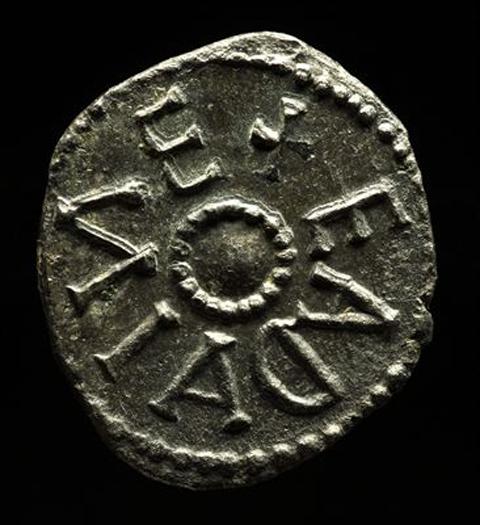
The rare Anglo-Saxon coin found at the minster shows that the city had its own mint [Credit: Maev Kennedy/Guardian]

The recent excavation of a pair of Viking feet and a tiny silver Anglo-Saxon coin may lack the glamour of the discovery of the last Plantagenet, but it has shone a light on one of the least known periods in the long history of York Minister: the centuries between the fall of Roman empire and the coming of the Vikings, in AD866.

The coin, no bigger than a 5p piece, is a sceat, minted in York. It is in such good condition that experts at the British Museum first thought it was a Victorian fake. So good is its state of repair that marks are legible identifying the maker as Eadwine, who also minted coins for the Northumbrian court. It proves that York had enough status and wealth in the early 9th century to support its own mint.

The coin is so pristine it was probably never circulated, so the archaeologists surmise that it was dropped accidentally almost as soon as it was struck, and that the mint must therefore have been very close to the site of the present enormous medieval church, which was built over layers of earlier foundations, some of them Roman.


Read the rest of this article...
Wednesday, 30 January 2013

Escrick sapphire ring's mystery history sparks meeting


The style and material of the ring makes it hard to date the university said


A sapphire ring found in North Yorkshire has sparked a meeting of experts to determine exactly when it was made.

The ring has baffled archaeologists because it is unlike any other according to the Yorkshire Museum.
The intricate ring, presumably made by a highly skilled craftsman, is on show at the Museum in York.
Natalie McCaul, from the museum, said the meeting may "shed new light on the ring" and "reveal some of its secrets".
The museum said the ring's style and material made it hard to date but it could have been made any time during the seventh to 11th centuries.


Read the rest of this article...

Monday, 14 January 2013

Archeologist who found 1,400-year-old grave of princess signs copies of his new book

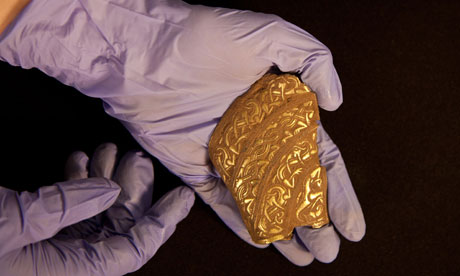
ROYAL FIND: Dr Steve Sherlock, who discovered the Saxon Princess jewellery at Loftus, a piece of which is shown below, signs copies of his book at Kirkleatham Museum 
 
THE archaeologist behind one of the most important discoveries ever made in the region held a book signing session this weekend. 

Dr Steve Sherlock discovered a striking 7th century gold pendant, which would have belonged to a princess, as well as glass beads, pottery, iron knives and other objects, in Loftus, East Cleveland between 2005 and 2007. 

The finds, which were described as “unparalleled” by experts, now form the Saxon Princess display at Redcar’s Kirkleatham Museum. 

The Princess was buried with her jewellery about 1,400 years ago and the haul was discovered at the only known Anglo-Saxon royal burial site in the North-East.

Read the rest of this article...

Friday, 11 January 2013

Staffordshire Hoard grows as 81 further pieces declared treasure trove

Some of the pieces of gold and silver which have been declared part of the Staffordshire Hoard. Photograph: Staffordshire County Council/PA
Anglo-Saxon gold and silver found in a field in the West Midlands has been declared treasure trove and part of the Staffordshire Hoard.

The 81 items, which date to the seventh century, will be handed to the British Museum's valuation committee to assess their worth, South Staffordshire coroner Andrew Haigh told an inquest in Stafford on Friday. It will then be up to Staffordshire county council and neighbouring councils to raise the money to buy the new items for the nation. The original hoard, with 3,900 items, was bought for £3.3m after being found in a field near Lichfield in 2009 by metal detectorist Terry Herbert. He split the money with Fred Johnson, the farmer who owned the land. Though a team from Archaeology Warwickshire discovered the second haul last year, proceeds from the sale will once again go to Herbert and Johnson. The most interesting finds included an eagle mount, whose use is not known, and a cheek piece from a helmet.

Philip Atkins, leader of Staffordshire council, said it and the owners of the original hoard, Stoke-on-Trent and Birmingham councils, would now have to look at raising money to buy the new items.

Read the rest of this article...

Staffordshire Hoard duo in fresh windfall from new 'treasure' find

Terry Herbert from Burntwood, Staffordshire, with some of the pieces which made up 
an Anglo-Saxon hoard


More than 80 Anglo-Saxon gold and silver items found buried in a field near Lichfield were ruled to be part of a collection dubbed the Staffordshire Hoard. 
After they were yesterday declared a treasure trove, experts from British Museum's valuation committee were instructed to assess their worth. 
Staffordshire County Council and neighbouring councils will also attempt to raise the money to buy the new items, which date to the 7th century, for the nation. 
The haul will likely to end up in museums with the original Staffordshire Hoard, which was found in a field in 2009 by metal detectorist Terry Herbert, 57.

Read the rest of this article...

Tuesday, 18 December 2012

Staffordshire hoard site yields further 90 fragments

Staffordshire hoard: part of a helmet was among the pieces unearthed in the Hammerwich field last month. Photograph: Staffordshire county council/PA

Gold and garnet cross and eagle-shaped mount among latest items unearthed by archaeologists in Hammerwich field


More gold and silver, including a gold and garnet cross, an eagle-shaped mount, and what could be a helmet cheek piece, have been churned up by ploughing in Staffordshire in the same field which three years ago yielded one of the most spectacular Anglo Saxon hauls.

When archaeologists first scoured farmer Fred Johnson's field in Hammerwich and discovered the hoard, which comprised more than 3,500 fragments of metalwork including sword, shield and helmet mounts inlaid with pieces of garnet and enamel, they left convinced they had emptied it of every scrap of treasure. Now a 90 further pieces have been found.

The workmanship in the new finds appears identical to pieces from the original haul; the helmet cheek piece appears to match one found three years ago.

Read the rest of this article...

Staffordshire Hoard: Gold fragments found in Hammerwich


About 90 more pieces of gold and silver believed to belong to the Staffordshire Hoard have been found.

The discovery was made by archaeologists in the same Staffordshire field at Hammerwich where 3,500 pieces were found in 2009.

Some of the new pieces are fragments that fit with parts of the original hoard of Anglo-Saxon gold and silver.

They include a possible helmet cheek piece, a cross shaped mount and an eagle shaped mount.

Read the rest of this article...
Monday, 17 December 2012

Saxon graves uncovered at St Margaret's


Five Saxon graves have been discovered by archaeologists at St Margaret’s. The graves were unearthed at The Droveway by Keith Parfitt, of the Canterbury Archaeological Trust, who also discovered Dover’s Bronze Age Boat 20 years ago.

Items found in the graves, including a warrior’s shield, are now being cleaned so that they can be studied more closely. It is hoped they might be put on display at Dover Museum.

Mr Parfitt and his team had been called ahead of plans to build on the site and initial excavations indicated there may well be graves there.

A few weeks ago, before the builders moved in, the archaeologists carried out a more thorough excavation and found five graves. One was believed to have been that of an elderly woman where a brooch was found and another was of a warrior who was buried with his shield.

“The graves were quite widely spaced apart, unlike the Anglo Saxon cemetery which we uncovered at Buckland,” said Mr Parfitt.

Read the rest of this article...

Sunday, 16 December 2012

University of Oxford Online Courses in Archaeology


Now is the time to enrol for Hilary term online courses in Archaeology.

Each courses lasts for 10 weeks, with the expectation of c. 10 hours study a week.  Students submit two short assignments.   

Successful completion of the courses carries a credit of 10 CATS Points.

CATS Points from these courses can now be used as part of the requirement for the new Certificate in Higher Education offered by the University of Oxford.

The following courses are available: (click on the title for further information)


Greek Mythology                  Origins of Human Behaviour               Pompey and the cities                                                                                                         of the Roman World

Ritual and Religion in Prehistory                          Vikings: Raiders, Traders and Settlers

You can find general information about University of Oxford courses here...

Monday, 26 November 2012

Anglo-Saxon treasure reveals west Norfolk cremation


Fragments of an early Anglo-Saxon silver brooch found in Norfolk has given archaeologists new evidence of a cremation burial in the area.

Experts say the 6th Century brooch, found near West Acre, could possibly have originated in mainland Europe.

The brooch, along with a Medieval copper coin-like medal known as a jetton and a Middle Anglo-Saxon sword belt mount, has been declared treasure.

An expert from the British Museum said the 13th Century jetton was "unusual".

Read the rest of this article...

Sunday, 18 November 2012

Summer Courses in Archaeology

Oxford Experience Archaeology Courses

The Oxford Experience Summer School offers weekly introductory courses in the Sciences and Humanities.  Participants stay in Christ Church, the largest and one of the most beautiful Oxford Colleges.


You can find out more about the Oxford Experience here...

Monday, 5 November 2012

Archaeologists reveal rare Anglo-Saxon feasting hall


A rare Anglo-Saxon feasting hall has been spectacularly uncovered by a team of archaeologists from the University of Reading working at Lyminge in Kent. The Guardian have today featured this amazing discovery in the newspaper and on their website.

This is the first discovery of a previously unknown Anglo-Saxon ‘Great Hall' in over 30 years and one of only a handful of such major buildings to be excavated in its entirety. Large enough to accommodate up to 60 people and forming part of a formal complex of buildings, the hall would have been used as a venue for royal assemblies attended by the king and his armed entourage.

The current excavations, funded by the Arts and Humanities Research Council (AHRC) with support from project partners Kent Archaeological Society and staff from the Canterbury Archaeological Trust, are designed to shed new light on Lyminge as a key site for understanding the origins of Christianity in Anglo-Saxon England.

Read the rest of this article...

Saxon find in Lyminge has historians partying like it's 599


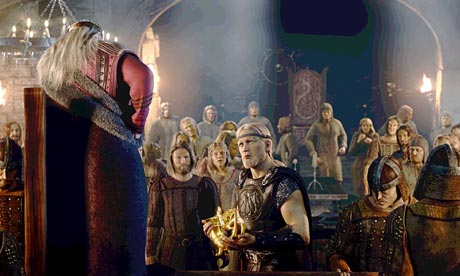
A still from the 2007 motion-capture film Beowulf. The epic poem featured a great hall of its own, Heorot, whose ‘radiance shone over many lands’. Photograph: Paramount/Everett/Rex Features
 
The foundations of a spectacular Anglo-Saxon feasting hall, a place where a king and his warriors would have gathered for days of drinking and eating – as vividly described in the poem Beowulf – have been found inches below the village green of Lyminge in Kent.

There was one last celebration by the light of flickering flames at the site, 1,300 years after the hall was abandoned, as archaeologists marked the find by picking out the outline of the hall in candles, lighting up the end-of-excavation party. Heaps of animal bones buried in pits around the edge of the hall bore testimony to many epic parties of the past.

The unexpected find, by a team from the University of Reading funded by the Arts and Humanities Research Council and working with local archaeologists and villagers, is exceptionally rare. Digging under the curious gaze of drinkers in the garden of the Coach and Horses pub a few metres away, it is the first great hall from the period to be discovered in more than 30 years.

Read the rest of this article...

Anglo-Saxon hall found in Kent is 'tip of the iceberg'


An Anglo-Saxon feasting hall unearthed beneath a village green in Kent could represent the "tip of the iceberg", according to archaeologists who believe it lies amid an entire complex of ancient buildings. 

The rare 7th to 9th century hall, which would have accommodated up to 60 people during royal feasts, was the first to be discovered in more than 30 years when it was excavated by Reading University experts this summer. 
But further developments are expected over the coming years as researchers plan to scour the surrounding area in the hope of finding an entire network of other buildings. 
Feasting halls like the one uncovered in Lyminge, which contained jewels, animal bones and a broken horse's harness, were always part of a larger complex of houses built for accommodation and other ceremonial purposes during royal visits, experts explained.

Read the rest of this article...