Monday, 5 November 2012

Anglo-Saxon hall found in Kent is 'tip of the iceberg'


An Anglo-Saxon feasting hall unearthed beneath a village green in Kent could represent the "tip of the iceberg", according to archaeologists who believe it lies amid an entire complex of ancient buildings. 

The rare 7th to 9th century hall, which would have accommodated up to 60 people during royal feasts, was the first to be discovered in more than 30 years when it was excavated by Reading University experts this summer. 
But further developments are expected over the coming years as researchers plan to scour the surrounding area in the hope of finding an entire network of other buildings. 
Feasting halls like the one uncovered in Lyminge, which contained jewels, animal bones and a broken horse's harness, were always part of a larger complex of houses built for accommodation and other ceremonial purposes during royal visits, experts explained.

Read the rest of this article...

Monday, 15 October 2012

The Anglo-Saxons are coming!

Producer Beaty Rubens introduces a new, extended series of The Essay on Radio 3 – three blocks of ten episodes stretching in to 2013, the first series beginning on Monday 15th October.

I was interested in the Anglo-Saxons – that wasn’t the problem.  In fact, I had attended a primary school called King Alfred’s, and even today could sketch you the school logo – a wonky little line drawing of Alfred, seated on a throne, wearing a sort of Anglo-Saxon dress and pointy shoes and holding up a book to show off his passion for education.  Which is ironic, really, because education – or my lack of it – on the subject was exactly why I felt so unqualified to produce a 30-part series called Anglo-Saxon Portraits.

I knew something about the Celts and the Romans and the Tudors, but the half millennium between the departure of the Romans and the arrival of the Normans was a shocking blank.  Perhaps the Anglo-Saxons just weren’t much taught in the 50 years after the War, when the idea of Aryan and Germanic invaders wasn’t all that fashionable. 

Read the rest of this article...
Thursday, 11 October 2012

Archaeology Summer Courses in Oxford


The Oxford Experience, Christ Church, Oxford

The Oxford Experience summer school offers one-week introductory classes in the humanities and sciences, including a number of archaeology courses.

You can find details of the Oxford Experience summer school here...

You can find a list of the archaeology courses here...

Thursday, 4 October 2012

Oxford Experience on Facebook


The Oxford Experience - an Oxford University summer school that offers many courses in archaeology and history - now has a Facebook site.

You can find the site at: www.facebook.com/OxfordExperience


You can find out more about the Oxford Experience here...

Thursday, 27 September 2012

Westminster Abbey staff clean floor around Edward the Confessor's tomb


Conservation staff at Westminster Abbey clean the Cosmati pavement surrounding the tomb of Edward the Confessor and asses it for conservation on Sept. 24 in London, England.

The highly decorative stone pavement is formed of small precious stones such as onyx and porphyry on a base of dark limestone, known as Purbeck marble.

A shrine was erected in 1163 following the Confessor's canonisation and St Edward's body was brought in on October 13, 1269 to its new resting place.

The Cosmati pavement provides the flooring around Edward the Confessor's tomb behind the High Altar of Westminster Abbey where the Duke and Duchess of Cambridge signed their marriage register.

Read the rest of this article...

Monday, 10 September 2012

Ipswich waterfront Saxon dig unearths 300 graves


An archaeological dig at Ipswich waterfront has unearthed 300 skeletons and evidence of an old church.

The excavation is taking place before 386 homes are built on Great Whip Street by Genesis Housing Association.

It is believed the Saxons occupied the site in the 7th Century and burials are believed to have taken place there until the 16th Century.

Rubbish pits were also uncovered during the dig, led by Oxford Archaeology and Pre-Construct Archaeology.

Paul Murray, senior project officer with Oxford Archaeology, said: "A certain amount of historical research was done before we got here, so we had a general idea of what to find, but this has exceeded our expectations.

Wednesday, 8 August 2012

Soldiers injured in Afghanistan make surprise find on UK archaeology dig


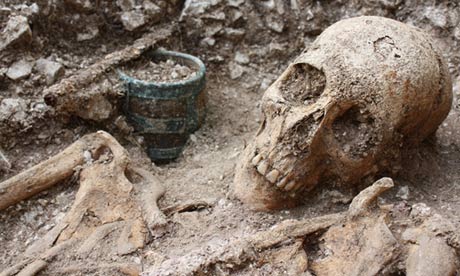
Remains of an Anglo Saxon warrior, buried with his spear and a bronze-bound drinking cup, after he was was discovered by modern soldiers on a rehabilitation programme. Photograph: Ministry of Defence
 
An excavation on Salisbury plain has proved an unusually emotional experience for the volunteer archaeologists, as soldiers recovering from injuries received in Afghanistan have made a surprise discovery: the remains of warriors who died more than 1,400 years ago.

Led by the Defence Infrastructure Organisation (DIO) and the Army, partners from Wessex Archaeology were astonished by the haul. Operation Nightingale is an award-winning project to give soldiers new skills and interests as part of their rehabilitation. The excavation was expected to produce modest results after earlier digs had turned up empty army ration packs and spent ammunition. Instead, they revealed their ancient counterparts, including an Anglo Saxon soldier buried with his spear and what must have been a treasured possession, a small wooden drinking cup decorated with bronze bands.

Saturday, 28 July 2012

Discovery of early medieval royal stronghold in southwest Scotland

Trusty's Hill Pictish carving. Image: Galloway Picts Project

A recent Heritage Lottery funded archaeological excavation has discovered a hitherto forgotten early medieval royal stronghold in Scotland.

Pictish symbols

Trusty’s Hill, near Gatehouse of Fleet in Dumfries and Galloway, is best known for the Pictish Symbols carved into a natural rock outcrop at the fort’s entrance.  However, in recent years, many historians have begun to doubt whether these carvings were genuine, some even suggesting that the carvings are forgeries. The Galloway Picts Excavation, led by the Dumfriesshire and Galloway Natural History and Antiquarian Society and funded in part by the Heritage Lottery Fund, sought to find out why there are Pictish Carvings here, so far from the Pictish heartlands in the north-east of Scotland, and if the carvings are indeed genuine.

Under the direction of two members of the Society, over 60 local volunteers, assisted by professional archaeologists from GUARD Archaeology Ltd, spent two weeks discovering new archaeological evidence that establishes a clear archaeological context for the Pictish Symbols at this vitrified fort.

Christian burial ground unearthed in West Cumbria


When excavation work started on Camp Farm adjacent to the Senhouse Museum archaeologists believed they were looking at late Roman buildings. Their recent find of four graves and what appears to be a church shows how life evolved after the fall of the Roman Empire. 

Site director Tony Wilmott said the find uncovered 'Maryport's missing centuries' and is of national significance.

The graves are believed to have been from the 5th or 6th century. The team to be able use the fragments of teeth and bone found buried to accurately date the site using carbon dating. 
 

Thursday, 26 July 2012

Work starts on Easter Ross's Nigg cross-slab


Detail on the Nigg cross-slab which dates from the 8th Century AD

Conservation work has started on an intricately carved Pictish stone from Easter Ross.

The Nigg cross-slab dates from the 8th Century AD and features snakes and a depiction of monks receiving bread from a raven sent by God.

Nigg Old Trust received grants towards the £180,000 restoration project.

The monument has been taken to a workshop in Edinburgh and will eventually be put back on display at 16th Century Nigg Old Church.

The cross-slab is one of Scotland's greatest art treasures, according to the trust.
The stone's entry in the Highland Historic Environment database described it as being intricately carved.

Wednesday, 11 July 2012

Climate in Northern Europe Reconstructed for the Past 2,000 Years: Cooling Trend Calculated Precisely for the First Time


An international team that includes scientists from Johannes Gutenberg University Mainz (JGU) has published a reconstruction of the climate in northern Europe over the last 2,000 years based on the information provided by tree-rings. Professor Dr. Jan Esper's group at the Institute of Geography at JGU used tree-ring density measurements from sub-fossil pine trees originating from Finnish Lapland to produce a reconstruction reaching back to 138 BC. In so doing, the researchers have been able for the first time to precisely demonstrate that the long-term trend over the past two millennia has been towards climatic cooling.

"We found that previous estimates of historical temperatures during the Roman era and the Middle Ages were too low," says Esper. "Such findings are also significant with regard to climate policy, as they will influence the way today's climate changes are seen in context of historical warm periods." The new study has been published in the journal Nature Climate Change.

Was the climate during Roman and Medieval times warmer than today? And why are these earlier warm periods important when assessing the global climate changes we are experiencing today? The discipline of paleoclimatology attempts to answer such questions.

Wednesday, 27 June 2012

Oakington: Life and death in the East Anglian Fens


Anglo-Saxon skeletons have been surfacing for almost a century in the fields of Oakington. Now a new project has laid bare the trials and tragedies of a small 6th-century Fenland community. Duncan Sayer, Richard Mortimer and Faye Simpson bring flesh to the bones.


 In 1926 four early Anglo-Saxon burials, one equipped with a spear, knife and shield boss, were discovered in an Oakington village field, in Cambridgeshire. Described as ‘[south] of the church’, the land had just been bought by Alan Bloom for his nursery garden. His interest piqued, Alan dug dozens more holes, only abandoning the hunt for further bodies when he hit undisturbed subsoil. Yet there were more to find. Construction of a children’s playground in the 1990s brought 26 burials to light, excavated by Cambridgeshire’s Archaeological Field Unit, while 2006 and 2007 saw Oxford Archaeology East recover 17 more. In 2010 and 2011 students and researchers returned to the site, opening new trenches on either side of the playground and revealing 27 further burials – including a pregnant woman, a warrior and, most exceptional of all, a large number of child burials from a period when they are notoriously scarce.

With several seasons left to go, Oakington is fully established as a substantial 6th-century Anglo-Saxon cemetery. But there is more to the site than that. Capitalising on the longer view that a research and community project provides, test pits and whole trenches have been excavated in gardens and open spaces throughout the village. The tantalising results point to an early enclosed community – a Middle Saxon Burh – on the edge of the Cambridgeshire Fen.

Cow and woman found in Anglo-Saxon dig


Archaeologists excavating an Anglo-Saxon cemetery in Cambridgeshire say the discovery of a woman buried with a cow is a "genuinely bizarre" find. 

Archaeologists described the find as "unique in Europe" [Credit: BBC]
The grave was uncovered in Oakington by students from Manchester Metropolitan University and the University of Central Lancashire. 

At first it was thought the animal skeleton was a horse. 


Student Jake Nuttall said: "Male warriors might be buried with horses, but a woman and a cow is new to us." 


He added: "We were excited when we thought we had a horse, but realising it was a cow made it even more bizarre." 


Co-director of the excavation, Dr Duncan Sayer, from the University of Central Lancashire, said: "Animal burials are extremely rare, anyway.

Monday, 21 May 2012

Anglo-Saxons and hand-saex


As an invitation to explore the wonders of Old English, hand-saex is certainly arresting.

The Dictionary of Old English, based at the University of Toronto (doe.utoronto.ca), offered hand-saex as last week’s “word of the week.” Reader Susannah Cameron spotted it and sent the reference to Word Play. “Have to admit it caught my attention,” she said.


Sadly for anyone expecting new insight into the intimate practices of Anglo-Saxons between the years 600 and 1150, the word refers to a knife or dagger. The knife was a saex, also spelled seax and (yes) sex, and a hand-saex was a weapon held in one hand. The word for hand in Old English was hand. Very handy.

Saex comes from a Germanic root (sah or sag) meaning to cut. It survives today only in the narrowly defined word sax, a tool used to trim roofing slates. But before the Norman Conquest of 1066 reshaped the English language and gave us Middle English – a process that took about a century to filter down to ordinary folks – saex was all the rage.

New Look for the Current Archaeology Website


Current Archaeology now has a dedicated news editor in-house, and the news articles are now posted on our website as the stories break rather than simply published in the magazine.  You can also subscribe to receive an email newsletter, and there are RSS feeds for your newreader as well.

Go to the Current Archaeology Website...

NEWS RSS: http://www.archaeology.co.uk/category/articles/news/feed
Twitter Feed: https://twitter.com/#!/CurrentArchaeo

The Current World Archaeology website has also been updated.

Go to the Current World ArchaeologyWebsite...

NEWS RSS: http://www.world-archaeology.com/category/news/feed
ARTICLE RSS: http://www.world-archaeology.com/category/features/feed
TWITTER: https://twitter.com/#!/WorldArchaeo

Sunday, 13 May 2012

Abbey excavations reveal Saxon glass industry


New research led by the University of Reading has revealed that finds at Glastonbury Abbey provide the earliest archaeological evidence of glass-making in Britain. 


Professor Roberta Gilchrist, from the Department of Archaeology, has re-examined the records of excavations that took place at Glastonbury in the 1950s and 1960s. 

Glass furnaces recorded in 1955-7 were previously thought to date from before the Norman Conquest. However, radiocarbon dating has now revealed that they date approximately to the 680s, and are likely to be associated with a major rebuilding of the abbey undertaken by King Ine of Wessex. Glass-making at York and Wearmouth is recorded in historical documents in the 670s but Glastonbury provides the earliest and most substantial archaeological evidence for glass-making in Saxon Britain. 

The extensive remains of five furnaces have been identified, together with fragments of clay crucibles and glass for window glazing and drinking vessels, mainly of vivid blue-green colour. It is likely that specialist glassworkers came from Gaul (France) to work at Glastonbury. The glass will be analysed chemically to provide further information on the sourcing and processing of materials.

Thursday, 10 May 2012

Glastonbury Abbey excavations reveal Saxon glass industry


(Phys.org) -- New research led by the University of Reading has revealed that finds at Glastonbury Abbey provide the earliest archaeological evidence of glass-making in Britain.

Professor Roberta Gilchrist, from the Department of , has re-examined the records of excavations that took place at Glastonbury in the 1950s and 1960s.

furnaces recorded in 1955-7 were previously thought to date from before the Norman Conquest. However, has now revealed that they date approximately to the 680s, and are likely to be associated with a major rebuilding of the abbey undertaken by King Ine of Wessex. Glass-making at York and Wearmouth is recorded in historical documents in the 670s but Glastonbury provides the earliest and most substantial for glass-making in Saxon Britain.

The extensive remains of five furnaces have been identified, together with fragments of clay crucibles and glass for window glazing and drinking vessels, mainly of vivid blue-green colour. It is likely that specialist glassworkers came from Gaul (France) to work at Glastonbury. The glass will be analysed chemically to provide further information on the sourcing and processing of materials.

Tuesday, 8 May 2012

Glastonbury Abbey excavations find Saxon glass industry


New research on glass fragments found at Glastonbury Abbey in the 1950s reveals the earliest archaeological evidence of glass-making in Britain.

Researchers from the University of Reading carried out radiocarbon dating on finds from the digs.

Clay crucibles and pieces of vivid blue-green window glass were tested.

The results show the pieces date from the 680s and are likely to be associated with a major rebuilding of the abbey by King Ine of Wessex.

Saturday, 5 May 2012

Graves unearthed in Caistor dated to seventh century


An exciting excavation in Caistor could prove to be "sensational" should carbon dating results prove it contains remains from late Roman to Middle Saxon times. 

Site supervising archaeologist Fiona Walker works on a full length skeleton found at the old Talbot Inn site in Caistor prior to the building of the Co-operative store opened in late 2010 [Credit: Grimsby Telegraph]
As reported, the Talbot Skeletons were found during a dig which took place before the building of the Caistor Co-operative store two years ago. 

Carbon dating on two of the skeletons has revealed they are not from the Roman era as originally believed, but from the seventh century, which was during the Anglo Saxon period.

Tuesday, 1 May 2012

Oxford Online Courses in Archaeology


The University of Oxford's online courses in archaeology for Trinity term are now open for enrolment.

"Cave paintings, castles and pyramids, Neanderthals, Romans and Vikings - archaeology is about the excitement of discovery, finding out about our ancestors, exploring landscape through time, piecing together puzzles of the past from material remains.
"Our courses enable you to experience all this through online archaeological resources based on primary evidence from excavations and artefacts and from complex scientific processes and current thinking. Together with guided reading, discussion and activities you can experience how archaeologists work today to increase our knowledge of people and societies from the past."
You can find the full list of courses here...