Thursday, 19 December 2013

1066 and all that


The traditional location for the Battle of Hastings - the site of Battle Abbey - has been called into question.

New research by the Time Team shows that the Battle of Hastings was not fought on the site where it was believed to have taken place. In recent years other theories have been put forward to suggest where the battle took place, but work by the Time Team has shown good arguments for a new location.

Trevor Rowley will discuss the new information in his Oxford Experience course 'William the Conqueror' and incorporate it into the field trip to the battle site. This which will mean that Trevor's students will be amongst the first visitors to the new location.

You can register for Trevor's 'William the Conqueror' course here...

Battle of Hastings 'fought at site of mini roundabout'


Channel 4's Time Team believe they have identified the site of the Battle of Hastings and death of King Harold - now occupied by a mini roundabout


It might seem an inauspicious spot for one of the most seminal moments in the nation’s history.
But new research suggests that the death of King Harold in battle against William the Conqueror’s men actually occurred, not on the site of the high altar of Battle Abbey, where it is commemorated, but on a mini roundabout.
The precise location for the Battle of Hastings has long been in dispute, with competing historians making claims for three rival sites.
Now, an investigation by Channel 4’s Time Team has concluded the battle – and the death of England’s last Anglo-Saxon king – was actually centred on a fourth site: a road junction on the A2100 in East Sussex.
Read the rest of this article...

Thursday, 5 December 2013

Building is underway at The new Wessex Gallery of Archaeology, The Salisbury Museum

Anglo-Saxon satchel mount c.700 AD. Gold and Silver foils with repoussé decoration. 
Found with the burial of an Anglo-Saxon ‘princess’ at Swallowcliffe, Salisbury.
Amesbury Archer Gold Hair Tresses - 2,300 BC. The oldest gold objects found in Britain, 
Copyright Ken Geiger/National Geographic.
Polished macehead made from gneiss found with a cremation burial at Stonehenge,  3,000 – 2,500 BC.

Building is underway at The new Wessex Gallery of Archaeology, 
The Salisbury Museum

Building has begun on the new Wessex Gallery at the Salisbury Museum, which will make it clear for the first time exactly why Salisbury and it’s nearby World Heritage Sites hold a unique place in British history.

The new gallery will be of international importance, telling the story of Salisbury and the surrounding area from prehistoric times to the Norman Conquest. Realm Projects, the Nottinghamshire based builders who worked on the Hepworth Wakefield and The Jewish Museum, have been contracted to complete the works.

“By Christmas this year the major construction work will be complete,” said museum director Adrian Green with a gleam in his eye. “In roughly seven months, the new Wessex Gallery will be ready.”

Read the rest of this article...

Tuesday, 26 November 2013

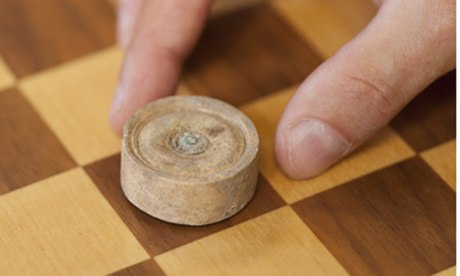
Ancient board game piece unearthed at Lyminge dig


A 7th century board game piece, the first discovery of its kind for 130 years, has been unearthed in Kent by University of Reading archaeologists.

Ancient board game piece unearthed at Lyminge dig
The piece is made from a hollow cylinder of bone and has a central bronze
rivet [Credit: University of Reading]
Researchers believe the hollow bone cylinder found at the Lyminge dig belongs to an early backgammon or draughts-type games set.

It was found in the remains of an Anglo-Saxon royal hall where board games were traditionally very popular.

Project leader Dr Gabor Thomas called it a "wonderfully evocative discovery".


Read the rest of this article...

Gambling of high-living Anglo-Saxons revealed by archaeological find

The Anglo-Saxon gaming piece found in the Kent village of Lyminge.
Photograph: Design and Print Studio/University of Reading
It would have been a very expensive toy, expertly crafted and imported across the Channel – and archaeologists say it provides a glimpse of the luxurious life of Anglo-Saxon nobles in 7th-century Kent.
The little gaming piece is the only one discovered at an Anglo-Saxon habitation site, although many cruder examples have been found in graves. It is the first piece of such quality found since the excavation of a princely grave in Buckinghamshire in the 1880s.
"This piece comes from a high-end – Harrods – backgammon set," the Reading University archaeologist Gabor Thomas said. "Not only high-end but quite possibly Italian – Ferrari – high-end, as the best parallels outside England are from the 6th-century Lombard kingdom. If such pieces are indeed of Lombardic manufacture, then the implication is that the kings of Kent enjoyed the latest fashions in gaming culture, courtesy of their far-reaching continental contacts."
Read the rest of this article...

Wednesday, 13 November 2013

Peterborough solar farm: Archaeologists unearth Roman finds


Roman pottery, evidence of a Roman settlement and "possibly Saxon" artefacts have been found at a proposed solar farm site near Peterborough.
The land at Newborough is being excavated ahead of a city council decision about the solar farm plan.
Richard O'Neill, from Wessex Archaeology, described the finds as "locally and regionally significant".
Work is expected to continue for three weeks, after which the council will consider the archaeologists' report.
Plans for the solar energy farm at three council-owned sites at Newborough, Morris Fen and America Farm were put on hold after English Heritage stepped in suggesting the area could be "nationally important".
Read the rest of this article...

Sunday, 29 September 2013

Mildenhall Museum ready for Anglo-Saxon warrior & horse

The warrior and his horse are being displayed as they were found in the grave at RAF Lakenheath

A Suffolk museum has taken delivery of the skeletal remains of an Anglo-Saxon warrior and his horse.
The remains were found in 1997 at RAF Lakenheath and they are going on display at nearby Mildenhall Museum.
The warrior is thought to have died in about AD 500 and the find included a bridle, sword and shield.
The bones are being displayed under glass in the same position they were found in and the public will be able to see them next month.
Suffolk Archaeological Service has been in charge of the skeletons, which were part of a cemetery containing 427 graves.
The warrior is believed to have been born locally and was about 30 years old when he died.
Read the rest of this article...

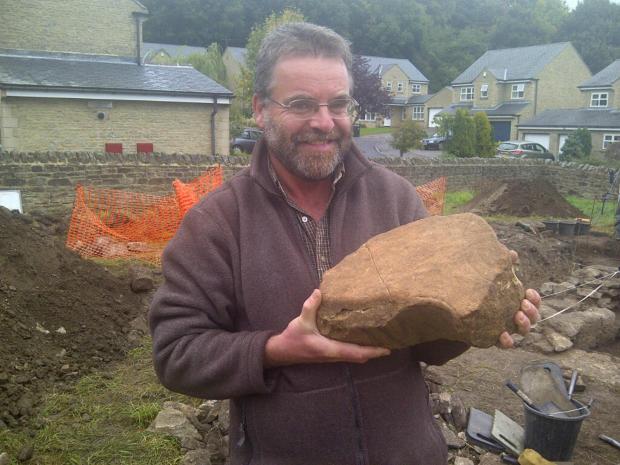
Archaeologists unearth section of an Anglo Saxon cross in Weardale

Paul Frodsham, of the AONB Partnership, shows off the section of an Anglo Saxon cross unearthed during a dig in Frosterley

ARCHAELOGISTS excavating a medieval church in a dales village have found further evidence that the site was an Anglo Saxon settlement.
A carved section from an eighth century stone cross was unearthed during a dig at St Botolph’s field in Frosterley in Weardale this week.
The discovery was met with great excitement from the archaeologists and volunteers who were digging on the site as part of the Altogether Archaeology project.
Paul Frodsham, historic environment officer at the North Pennines Area of Outstanding Natural Beauty (AONB) Partnership, which is leading the project, said: “This is not the kind of thing that happens every day
Read the rest of this article...

Tuesday, 24 September 2013

Norfolk dig uncovers Anglo-Saxon oven

The oven could be used for at least three tasks - to bake bread, malt barley and dry out grain

A structure uncovered by archaeologists in Norfolk has been confirmed as a 1,300-year-old "rare, multifunctional oven".
The Anglo-Saxon oven was found during an annual dig in Sedgeford, near Hunstanton.
Supervisor Dr John Jolleys said it would have been used to bake bread, malt barley and dry grain.
A second oven and a Saxon pot have also been discovered.
The volunteers initially thought the oven dated back to the Roman times, but the discovery of part of the Ipswich ware pot dated the oven to between 650 and 850 AD.
Read the rest of this article...

Monday, 9 September 2013

Saxon remains to be reburied after dig


Saxon remains found during an archaeological dig at an abbey in Warwickshire are being reburied at a church service later.

Saxon remains to be reburied after dig
Radiocarbon dates for the remains should be known in the next
three months [Credit: Peter Ralley/BBC]
Archaeologists working on a three year dig at Polesworth Abbey found up to 15 ancient burials. The dig has uncovered the pre-Norman abbey and a Saxon church.

Father Philip Wells, who is conducting the service, said it was not clear yet if the remains were those of nuns from the original abbey.

The results of radiocarbon dating on the remains should be known within the next three months.

A team of local volunteers have carried out the dig, supervised by professionals from the Northamptonshire Archaeological team. The work has been paid for by English Heritage.


Read the rest of this article...

Saxon graveyard unearthed in Suffolk


A team of archaeologists has returned to a Suffolk river bank to complete a dig at an early Christian burial site.

Saxon graveyard unearthed in Suffolk
The team has returned to the north bank of the River Alde
for a three-week dig [Credit: BBC]
A three-week excavation has begun at Barber's Point near Aldeburgh at a 7th Century Saxon graveyard. The team believes it is one of the first to reveal Christian rather than Pagan burial customs.

New funding has meant they hope to be able to complete work at the site after previous digs in 2004, 2007 and 2010 where 12 graves were discovered.

David Rea was among the volunteers forced to leave the site when funding ended.


"You could clearly see, etched against the wall where we were digging, that there was another grave, but it was the last day so we had to pack up and leave. But I told 'him' we'd be back and here we are and next week we shall be in there."

The team has been able to return because of a £24,000 boost from the Heritage Lottery Fund's Touching The Tide scheme.


Read the rest of this article...

Friday, 16 August 2013

Oxford Experience 2014


The programme for the Oxford Experience Summer School is now online.  Registration will not begin until late September, but now is the time to start planning your courses for next summer.

You can find the programme here...

Saturday, 27 July 2013

Traces of 'lost village' found in Nottinghamshire

Experts say the presence of Medieval pottery suggests the presence a community that possibly dates from before the Norman conquest

Remains of what archaeologists believe is a "lost village" have been found beneath a Nottinghamshire town.
Experts say the presence of cobbled surfaces and Medieval pottery found in the Burgage area of Southwell suggests the presence a community that possibly dates from before the Norman conquest.
Archaeologist Matt Beresford said the work was ongoing and they hoped to find more conclusive evidence.
The dig was backed by a £5,800 Heritage Lottery grant.
Read the rest of this article...

Possible Saxon bread oven found in Norfolk


A 1,300-year-old bread oven could have been discovered by a group of volunteer archaeologists in Norfolk.

Possible Saxon bread oven found in Norfolk
The suspected oven could have been used to provide bread for the community [Credit: BBC]
The annual dig in Sedgeford, near Hunstanton, has had about 100 people a week looking for signs of the village's past.

Supervisor Dr John Jolleys said the clay object, which he believes to be a Saxon bread oven, was found about 4ft 11in (1.5m) underground.

"It's rare and very exciting," Dr Jolleys said.

Excavation of the object will continue for the remainder of the dig, which finishes on 16 August.


Read the rest of this article...

Friday, 5 July 2013

Barrow Clump 2013: Phil's Round-up Week One


Following on from the fantastic success of the Operation Nightingale excavation at Barrow Clump last summer, the soldiers have returned for a second year. The 2013 excavations will explore new areas of this Bronze Age burial mound and aim to identify the extent of the Saxon cemetery.
Site Director, Phil Andrews has agreed to produce his popular weekly round-ups for the blog again this year, starting with week one below:
Here we go again!
A year passes very quickly and we started again at Barrow Clump last week, this time for five weeks until the end of July. Site camp was established, nettles cleared and trees trimmed, whilst the badgers appear to have temporarily vacated the site.
Read the rest of this article...

Tuesday, 2 July 2013

Saxon skeleton discovered in Lincoln Castle


A Saxon skeleton believed to be a king or bishop has been discovered in Lincoln Castle.


The Saxon skeleton was in a stone sarcophagus believed to date from about AD900.
Its sarcophagus has not yet been opened but an endoscopy revealed the remains were buried alongside other objects, such as gold.
Mary Powell, from Lincoln Castle, said: "We think it's somebody terribly important, possibly a bishop or a Saxon king.
"At the moment, we can see the side of the coffin, but not the lid. It's going to be incredibly challenging to get it out, so we are being very careful.
"There is a danger it could disintegrate because of the change in environmental conditions.
Read the rest of this article...

Tuesday, 25 June 2013

The Sutton Hoo Online Exhibition


In 1939, just before the outbreak of the Second World War, an archaeologist named Basil Brown excavated the largest of 18 burial mounds in the grounds of a country house at Sutton Hoo in the east of England. What he discovered turned out to be a spectacular undisturbed burial. 

Placed inside a vast ship, were the extraordinarily rich belongings of a high-ranking Anglo-Saxon man, possibly even a king...

View the online exhibition...

From Sutton Hoo to the soccer pitch: culture with a click


Museums, libraries and galleries are a tourist staple of the summer holiday season. Often they’re the first place we head to when visiting a new city or town in order to learn about the heritage of that country. Though only a lucky few have the chance to travel to see these treasures first-hand, the Internet is helping to bring access to culture even when you can’t visit in person. 

At the Google Cultural Institute, we’ve been busy working with our partners to add a range of new online exhibitions to our existing collection. With more than 6 million photos, videos and documents, the diversity and range of subject matter is large—a reflection of the fact that culture means different things to different people. What the exhibitions have in common is that they tell stories; objects are one thing but it’s the people and places they link to that make them fascinating. 

The British Museum is the U.K.’s most popular visitor attraction and the 4th most visited museum in the world. It’s well known for housing one of the most spectacular archaeological discoveries ever made—the 1,400 year old Anglo-Saxon burial from Sutton Hoo, untouched until its discovery in 1939. Their online exhibition “Sutton Hoo: Anglo-Saxon ship burial” explores the discovery of the ship, featuring videos of the excavation and photos of the iconic helmet and a solid gold belt buckle. All this tells the story of how the burial and its contents changed our understanding of what Anglo-Saxon society was like.


Read the rest of this article...

Sunday, 2 June 2013

HaNoA - Häfen im Nordatlantik


Der Hafen von Búðasandur, Hvalfjörður, Island. Die Überreste eines Handelsplatzes befinden sich in der Bildmitte, das mittelalterliche Hafengebiet (rechts) ist heute versandet (Foto N. Mehler).

Fast alle bedeutenden mittelalterlichen Häfen des nordeuropäischen Festlandes waren Teil größerer Siedlungen, aus denen sich häufig Städte entwickelten. Viele dieser Häfen hatten spezielle Einrichtungen wie z. B. Kaianlangen, Landebrücken und Lagerhallen, die einen gut entwickelten und organisierten Schiffsbetrieb und Warenumschlag ermöglichten. Völlig anders ist die Situation im Nordatlantikraum zu dieser Zeit. Im marginalen Siedlungsgebiet von Island, Grönland, Shetland und den Färöer Inseln gab es in der Wikingerzeit und im Mittelalter keine Städte. 

Read the rest of this article...

Tuesday, 14 May 2013

High-tech dig finds Roman farmstead


A high-tech research park is going to be built on land that once housed a Roman farmstead. An archaeological dig on the site of what will become the Haverhill Research Park has revealed traces of activity from the Iron Age through to the 1840s.
High-tech dig finds Roman farmstead
James Newboult said the size of the dig helped reveal the site's extensive history [Credit: BBC]
An Anglo Saxon hall and several pieces of jewellery were also found during the excavation, which covered 4.5 hectares.

Headland Archaeology said the dig had provided a "really interesting window" into Haverhill's history. The research park is being built on the A1307, the main road to Cambridge from Haverhill, and will also include a hotel and housing.


Read the rest of this article...