Tuesday, 11 March 2014

800-year-old monk found poking out of cliff face


The thigh bones of a medieval monk have been found poking out of cliffs at Monknash in South Wales which was a former burial ground in the Middle Ages

The remains of an 800-year-old monk that have been uncovered after his legs were spotted sticking out of cliff in Monknash, South Wales Photo: Wales News Service

The legs of an 800-year-old medieval monk have been discovered, poking out of a cliff face in Wales.
Although badly damaged and missing their knees, shins and feet, the thigh bones were found after the fierce recent storms caused severe coastal erosion.
They were spotted by rambler Mandy Ewington, who sent a photograph to coastal archaeologist Karl-James Langford.
Mr Langford, 39, said "I thought she must have been mistaken but I went down to see for myself and thought: "Bloody hell,this is amazing!
"You can clearly see a grave has been eroded into the sea.
Read the rest of this article...

'Awesome' Viking warship 'struck terror into people'


There are ghosts at the British Museum.

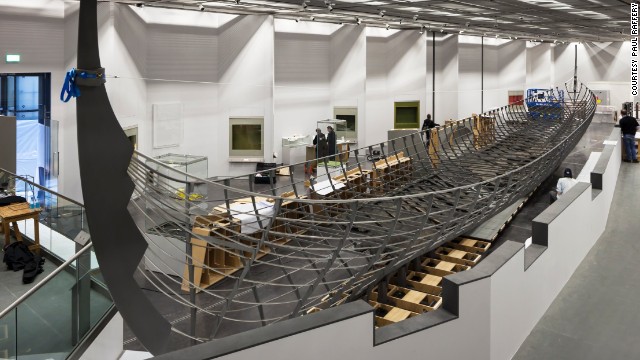
Hulking, hairy, bloodthirsty warriors grunting in unison as they row the biggest warship of its kind the world has ever known.

Can the gallery curator see them, or am I the only one? He laughs -- a little nervously: "Yes, you do get a sense of them."

Looming before us is Roskilde 6, the largest Viking ship ever discovered, carefully reconstructed after 1,000 years languishing beneath the waves. At 37 meters long it's double the size of the boat Christopher Columbus sailed to America.

Ghost armies or not, it is a sight to behold. The ship's fearsome metal frame seemingly rises from a watery netherworld on a mission to conquer the globe -- once and for all.

Read the rest of this article...

Saturday, 8 March 2014

The Vikings are here…


Gareth Williams, Exhibition Curator, British Museum
Lo, it is nearly thirty-five years since the Vikings last came to this Museum, and nobody believed that such an influx of fantastic material from overseas (as well as the UK) could be made…*
To be fair, the BP exhibition Vikings: life and legend lacks some of the drama of the original Viking attack on Lindisfarne in 793. We haven’t had fiery dragons in the sky (unless you count the Aurora Borealis coming unusually far south), and there hasn’t been much in the way of destruction or slaughter. Nor is it likely that this exhibition will be remembered 1200 years after the event, although in an age of globalised communication, there is no doubt that the exhibition has attracted considerably more notice in the last few days than the attack on Lindisfarne did at the time. Nevertheless, as the largest Viking exhibition in the UK for over 30 years, it has the potential to shape our definition of the Viking Age.
Read the rest of this article...

Friday, 28 February 2014

ANGLO-SAXON CEMETERY RESULTS QUESTION VIOLENT INVASION THEORY


The early fifth century transition from Roman Britain to Anglo-Saxon England is a poorly understood period in British history. Historical narratives describe a brutal conquest by Anglo-Saxon invaders with nearly complete replacement of the indigenous population, but aspects of the archaeological record contradict this interpretation leading to competing hypotheses.

A new study, published in the Journal of Archaeological Science, suggests a more peaceful process, according to Dr Andrew Millard, from Durham University, one of the paper’s lead authors.
‘The main controversy over the years has centred on how many Anglo-Saxons came across the North Sea,‘ he says, ‘Was it a mass invasion, where the existing population was wiped out completely or forced back into Wales, or was it a small band of elites whose ways were then adopted very quickly?’  The evidence the researchers have gathered favours the second option.
Read the rest of this article...

Shield-wearing skeleton, necklace and grave goods found in early Saxon inhumations


The discovery of nine bodies in Cambridgeshire could reveal much about the little-known early Saxon period

© Courtesy Pre-Construct Archaeology
An early Saxon man who fell on his shield has been found buried with a knife and spear alongside a jewellery-clad woman during a dig on a residential site in a Cambridgeshire village.

Grave goods, weaponry and everyday items from the 6th century surfaced during the excavation in Haddenham, where similar remains – including a double burial of a man and a woman – were first identified more than 20 years ago.

Read the rest of this article...

Tuesday, 25 February 2014

Haddenham dig yields finds dating back 1,400 years


Archaeologists gained a valuable insight into life and death in Saxon England thanks to a dig in Haddenham. 


A team of archaeologists from Pre-Construct Archaeology carried out an excavation within the village of Haddenham in advance of the construction of a residential dwelling. The dig uncovered burials dating to the Early Saxon period (6th century AD) 
[Credit: © Courtesy Pre-Construct Archaeology] 

At the start of the month, Pre-Construct Archaeology was invited to excavate a small site in the car park of the Three Kings pub, at the heart of the village, before developers moved on and began work on a new house. 

And, despite the dig taking place over a small site, the dig turned up a wealth of finds, including nine burials and plenty of grave goods in what experts believe was a Saxon burial ground.

Read the rest of this article...

Sunday, 23 February 2014

Village excavation turns up a wealth of finds dating back 1,400 years

A team of archaeologists from Pre-Construct Archaeology carried out an excavation within the village of Haddenham in advance of the construction of a residential dwelling. The dig uncovered burials dating to the Early Saxon period (6th century AD).

A team of archaeologists from Pre-Construct Archaeology carried out an excavation within the village of Haddenham in advance of the construction of a residential dwelling. The dig uncovered burials dating to the Early Saxon period (6th century AD).
At the start of the month, Pre-Construct Archaeology was invited to excavate a small site in the car park of the Three Kings pub, at the heart of the village, before developers moved on and began work on a new house.
And, despite the dig taking place over a small site, the dig turned up a wealth of finds, including nine burials and plenty of grave goods in what experts believe was a Saxon burial ground.
Read the rest of this article...

Monday, 17 February 2014

Diet hints at cultural shift in Anglo-Saxon Britain


Human remains dug up from an ancient grave in Oxfordshire add to a growing body of evidence that Britain's fifth-century transition from Roman to Anglo-Saxon was cultural rather than bloody. 


Anglo-Saxon burial site, Oxfordshire [Credit: Oxford Archaeology] 

The traditional historical narrative is one of brutal conquest, with invaders from the North wiping out and replacing the pre-existing population. But a new study, published in the Journal of Archaeological Science, hints at a more peaceful process. Dr Andrew Millard, from Durham University, is one of the study's authors.

Read the rest of this article...

Sunday, 16 February 2014

Ancient graves hint at cultural shift to Anglo-Saxon Britain

Anglo-Saxon burial site, Oxfordshire. Credit: Oxford Archaeology

Human remains dug up from an ancient grave in Oxfordshire add to a growing body of evidence that Britain's fifth-century transition from Roman to Anglo-Saxon was cultural rather than bloody.
The traditional historical narrative is one of brutal conquest, with invaders from the North wiping out and replacing the pre-existing population.
But a new study, published in the Journal of Archaeological Science, hints at a more peaceful process. Dr Andrew Millard, from Durham University, is one of the study's authors.
'The main controversy over the years has centred on how many Anglo-Saxons came across the North Sea,' he says.
Read the rest of this article...

Thursday, 6 February 2014

CULTURAL IDENTITY – CELTIC AND ANGLO-NORMAN REALMS


Jutting out from the edge of the Lake District and home to a proud industrial heritage, the Furness Peninsula seems to weld together many of our contrasting ideas about what Englishness means. To the north lies some of the country’s most outstanding areas of natural beauty; at the southern tip sits a shipyard where nuclear submarines for the Royal Navy are built. The area is defined by working-class values, post-industrial decline and 21st-century regeneration.
By uniting these elements, Furness appears to epitomise many of the complex ideas behind a notion of England that is both very modern, and very old.

Raises questions

But this, it turns out, is far from the complete picture. In a recent project, historians have begun to scratch the surface of a much earlier period in Furness’ past – one that not only changes what we know about its history, but also raises questions about these very ideas of Englishness itself.

Read the rest of this article...

Monday, 3 February 2014

Was Charlemagne a Mass Murderer?


When he heard of this, the Lord King Charles rushed to the place with all the Franks he could gather on short notice and advanced to where the Aller flows into the Weser. Then all the Saxons came together again, submitted to the authority of the Lord King, and surrendered the evildoers who were chiefly responsible for this revolt to be put to death – four thousand five hundred of them. The sentence was carried out.

This entry for the year 782 in the Royal Frankish Annals is one of the most debated topics of Charlemagne’s reign. Did the ‘Massacre of Verden’ actually happen with 4500 people being killed in a single day? Was the Carolingian ruler (and later Holy Roman Emperor) justified in his actions? Or was this a brutal act of ethnic-cleansing that has left a terrible mark on the man who is credited with re-establishing Western Europe after the fall of the Roman Empire?

Read the rest of this article...

Sunday, 2 February 2014

Summer Courses in Archaeology


The Oxford Experience Summer School


Courses in Archaeology


The Oxford Experience Summer School is held at Christ Church, Oxford

The Oxford Experience Summer School offers a number of one-week courses in archaeology as part of its programme.

Participants live in Christ Church - the largest of the Oxford Colleges - and take their meals in the Great Hall, which is the hall that inspired the Hogwarts Hall in the Harry Potter films.

Courses are limited to a maximum of twelve participants and tend to fill up rather quickly, so early application is advised.


Youcan find out more about the Oxford Experience here...

Training Digs for 2014


Now is the time to start thinking about training digs for the summer.

If you are planning to go on a training dig, take a look at our list here...

If you would like to submit details of a training dig (or any other archaeological event), please use the contact form here...

Friday, 31 January 2014

The Vikings are coming…

Iron axe-head found in the Thames at Hammersmith, Viking, 10th-11th century (1909,0626.8)

Tom Williams, Project Curator: Vikings, British Museum
Several years ago I worked at the Tower of London. Spending long periods of time within a building of such age, I would often start to wonder about how the area would have looked before the castle was built. Every morning I would pass the remains of Roman walls at Tower Bridge station, walls that were repaired and refortified by King Alfred the Great in response to the very real threat of Viking raids from the river. Blotting out the great hulk of HMS Belfast, Tower Bridge and the modern office blocks that now crowd the banks, I would try to imagine the awe and the terror that a Londoner would have felt a thousand years ago, standing on the city walls, watching the carved and gilded prows of dragon ships silently gliding up the Thames. Viking fleets and armies raided and besieged the city on numerous occasions, and the river has given up dozens of weapons that might have ended up there as a result of those conflicts.
Read the rest of this article...

Tuesday, 28 January 2014

Govan Stones: The Viking-Age treasures

The sarcophagus dates back to about AD 900

A unique collection of Viking-age monuments, which lay unloved in a Govan churchyard for 1,000 years, has attracted the attention of the British Museum. Its curator said the Govan Stones was one of the best collections of early medieval sculpture anywhere in the British isles.
Govan is well-known as an industrial powerhouse which, over the past 150 years, has built an incredible number of the world's largest ships.
However the town, now part of the city of Glasgow, has a long and largely-forgotten history as one of the earliest seats of Christianity in Scotland and the main church of the Kingdom of Strathclyde, the lost kingdom of the northern Britons.
In AD 870, Vikings, who had been based in Dublin, destroyed Dumbarton at the mouth of the Clyde, which had been a major power centre in the centuries after the Romans departed from Britain.
Read the rest of this article...

Thursday, 23 January 2014

British Museum launches The BP Exhibition Vikings: life and legend


In March 2014 the British Museum will open the Sainsbury Exhibitions Gallery with a major exhibition on the Vikings, supported by BP.

The exhibition has been developed with the National Museum of Denmark and the Staatliche Museen zu Berlin (National Museums in Berlin) and focuses on the core period of the Viking Age from the late 8th century to the early 11th century.
The extraordinary Viking expansion from the Scandinavian homelands during this era created a cultural network with contacts from the Caspian Sea to the North Atlantic, and from the Arctic Circle to the Mediterranean. The Vikings will be viewed in a global context that will highlight the multi-faceted influences arising from extensive cultural contacts. The exhibition will capitalise on new research and thousands of recent discoveries by both archaeologists and metal-detectorists, to set the developments of the Viking Age in context.
Read the rest of this article...

Sunday, 19 January 2014

Hilary Term Online Courses in Archaeology


Hillary Term begins tomorrow at Oxford, but there is still time to enrol for one of the online courses in archaeology.

Cave paintings, castles and pyramids, Neanderthals, Romans and Vikings - archaeology is about the excitement of discovery, finding out about our ancestors, exploring landscape through time, piecing together puzzles of the past from material remains.

These courses enable you to experience all this through online archaeological resources based on primary evidence from excavations and artefacts and from complex scientific processes and current thinking. Together with guided reading, discussion and activities you can experience how archaeologists work today to increase our knowledge of people and societies from the past.

The following courses are available:

Researchers claim to have found King Alfred's pelvis


Researchers said Friday they may have discovered remains of King Alfred the Great, the 9th-century royal remembered for protecting England from the Vikings and educating a largely illiterate nation. 

The portion of a pelvic bone said to belong either to Alfred, the only English king to have the moniker "Great", or his son King Edward the Elder was identified in remains dug up at a medieval abbey in Winchester, southwest England, the capital of Alfred's kingdom [Credit: University of Winchester] 

The University of Winchester said in a statement that a pelvis found in a box of bones in the city's museum is likely to be either from the legendary leader or his son, King Edward the Elder.

Read the rest of this article...

Bone fragment 'could be King Alfred or son Edward'

The fragment of pelvis dates back to the period in history when King Alfred died

A fragment of pelvis bone unearthed in Winchester in 1999 may belong to King Alfred the Great or his son Edward the Elder, academics have said.
It was found at a previous dig at Hyde Abbey and has been dated to 895-1017 - the era the king died.
Experts were originally testing remains exhumed last year from an unmarked grave at St Bartholomew's Church, where it was thought he was buried.
But they were found to be from the 1300s, not 899, when the king died.
The fragment of pelvis had been among remains stored in two boxes at Winchester's City Museum and was tested by academics at Winchester University after their study into the exhumed remains proved fruitless.
Read the rest of this article...

Anglo-Saxon remains found during Rushton excavation work

An early Anglo-Saxon pottery vessel, a skull and a bone were unearthed at one of the four graves

The remains of four Anglo-Saxon adults have been found in shallow graves during excavation work at a river in Northamptonshire.
The graves, 12in (30cm) below ground level, were found during the work to create a new backwater at the River Ise at Rushton near Kettering.
A 6th Century bowl was also found in the graves.
Archaeologists said they were "excited" by the graves, which have since been covered again with soil.
Jim Brown, senior project officer at Northamptonshire Archaeology, said the discovery of burial goods with the body remains indicated the people were "certainly pagan".
Read the rest of this article...