Saturday, 5 May 2012

Graves unearthed in Caistor dated to seventh century


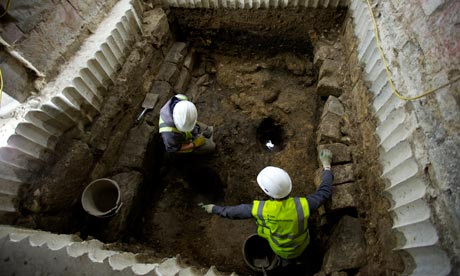
An exciting excavation in Caistor could prove to be "sensational" should carbon dating results prove it contains remains from late Roman to Middle Saxon times. 

Site supervising archaeologist Fiona Walker works on a full length skeleton found at the old Talbot Inn site in Caistor prior to the building of the Co-operative store opened in late 2010 [Credit: Grimsby Telegraph]
As reported, the Talbot Skeletons were found during a dig which took place before the building of the Caistor Co-operative store two years ago. 

Carbon dating on two of the skeletons has revealed they are not from the Roman era as originally believed, but from the seventh century, which was during the Anglo Saxon period.

Tuesday, 1 May 2012

Oxford Online Courses in Archaeology


The University of Oxford's online courses in archaeology for Trinity term are now open for enrolment.

"Cave paintings, castles and pyramids, Neanderthals, Romans and Vikings - archaeology is about the excitement of discovery, finding out about our ancestors, exploring landscape through time, piecing together puzzles of the past from material remains.
"Our courses enable you to experience all this through online archaeological resources based on primary evidence from excavations and artefacts and from complex scientific processes and current thinking. Together with guided reading, discussion and activities you can experience how archaeologists work today to increase our knowledge of people and societies from the past."
You can find the full list of courses here...

Monday, 23 April 2012

York Minster tantalises archaeologists with hints of Saxon church


What happened after the Romans left and the Vikings of Jorvik arrived? Two post holes and a jumble of bones may hold a clue

Field archaeologists Ian Milsted and Jim Williams in the dig site at York Minster
Field archaeologists Ian Milsted and Jim Williams in the dig site at York Minster that hints at Saxon remains. Photograph: Christopher Thomond for the Guardian

When the great west doors of York Minster swing open on Thursday and the Queen makes her way along the nave of the packed church for the ancient service of distributing Maundy Money, she will also be walking towards a small pit from which human bones have been pouring by the barrow load, the remains of some of the earliest Christians to worship on the site.

Tantalising finds include 30 skulls and a jumble of bones used to backfill a trench by the medieval builders of the present cathedral, and a man whose stone-lined and lidded grave was chopped off by Walter de Gray's 13th-century walls, leaving only his shins and feet in place.

Potentially the most significant finds are two nondescript round holes, with groundwater bubbling up through the mud. They are post holes that could date from the time of the earliest Christian church on the site, after the Roman empire disintegrated in the 5th century and before raiding Vikings arrived in the 8th century and the Normans in the 11th century.

Wednesday, 18 April 2012

Loftus Anglo-Saxon artefact haul wins cultural award


Jewellery on display at the exhibition  
Some of the jewellery on display at the exhibition
 
A collection of Anglo-Saxon artefacts discovered in East Cleveland has won a top prize at an Arts Council-sponsored cultural awards ceremony in Durham.

The treasure, found at a grave site in Loftus between 2005 and 2007, has been displayed at Kirkleatham Museum, Redcar, since May 2011.

It includes a gold pendant as well as iron knives, pottery and other objects.

The collection beat Newcastle's Great North Museum and the Beamish Museum to claim the Renaissance Museum Award.

Monday, 16 April 2012

Ridley Hall dig reveals Roman and Saxon finds


Archaeologists have found Roman and Saxon jewellery and tools in the grounds of a theological college in Cambridge.

The dig is in advance of the construction of a £9m extension at Ridley Hall. Archaeologists say animal bone and pottery suggest it was a settlement dating back to the Iron Age.

Sunday, 15 April 2012

Scientists find runes on ancient comb


Archaeologists have found the oldest engravings of letters ever to be discovered in central Germany, officials from the area announced on Thursday.

 The ancient letters, called runes, were scratched onto a 12.5 centimetre-long comb by Germanic settlers in the second century, scientists working on the site in Saxony-Anhalt believe.

The letters spell out “Kama”, meaning comb, the president of the state Heritage and Archaeology Management Office, Sven Ostritz, said on Thursday.

It is the oldest ever example of runic writing to be found in that part of the country, he added.

Monday, 26 March 2012

Vikings: Raiders, Traders and Settlers - Online Course


University of Oxford Department for Continuing Education
Mon 14 May to Fri 27 Jul 2012

Ravagers, despoilers, pagans, heathens - the Vikings are usually regarded as bloodthirsty seafaring pirates, whose impact on Europe was one of fear and terror. As they plundered the British Isles and the north Atlantic, these pagan invaders were seen by their Christian victims as a visitation from God.

Yet the Vikings were also traders, settlers and farmers with a highly developed artistic culture and legal system. Their network of trade routes stretching from Greenland to Byzantium and their settlements, resulted in the creation of the Duchy of Normandy in France, the foundation of the Kingdom of Russia in Kiev and Novgorod as well as the development of Irish towns including Cork, Dublin and Limerick.

This course will use recent findings from archaeology together with documentary records, to examine these varied aspects of the Viking world and to give a detailed and balanced view of this fascinating period.

Thursday, 22 March 2012

Photos: Bejeweled Anglo-Saxon Found in Christian "Burial Bed"


The skeleton of a young Christian noblewoman, who was laid to rest on a "burial bed" some 1,400 years ago, is giving archaeologists precious clues to the earliest days of the English church.

Unearthed in 2011 in a village near Cambridge (map), the teenager wore the badge of her faith in the shape of an exquisite gold-and-garnet cross, found on her chest and just visible in the picture above.

The ornate treasure marks the grave as one of the earliest known Christian burials in Anglo-Saxon England, researchers from the University of Cambridge announced last week.

Read the rest of this article...

Sunday, 18 March 2012

Remains of dark ages princess found in field in Cambridge


Cambridge University Archaeological Unit 
  view gallery VIEW GALLERY

The remains of a mysterious Anglo-Saxon princess, who died  thirteen and a half centuries ago, have been found in a field three miles south of Cambridge.

Aged just 16 when she died, and buried lying on a special high status funerary bed, she was laid to rest with a small solid gold, garnet encrusted, Christian cross upon her chest.

Her exact identity is as yet a complete mystery. However, it’s likely that she was a member of one of the newly Christianized Anglo-Saxon royal families of the period.

Read the rest of this article...

Saturday, 17 March 2012

UK experts find 7th-century teen buried in her bed


Archaeologists excavating near Cambridge have stumbled upon a rare and mysterious find: The skeleton of a 7th-century teenager buried in an ornamental bed along with a gold-and-garnet cross, an iron knife and a purse full of glass beads.

Experts say the grave is an example of an unusual Anglo-Saxon funerary practice of which very little is known. Just over a dozen of these "bed burials" have been found in Britain, and it's one of only two in which a pectoral cross _ meant to be worn over the chest _ has been discovered.

One archaeologist said the burial opened a window into the transitional period when the pagan Anglo-Saxons were gradually adopting Christianity.

Read the rest of this article...

Friday, 16 March 2012

Cross and bed found in Anglo-Saxon grave shed new light on 'dark ages'


Archaeologists in Cambridge thrilled to discover grave with body of young woman on a bed with an ornate gold cross

The dead are often described as sleeping, but archaeologists in Cambridgeshire have uncovered a bed on which the body of a young Anglo-Saxon woman has lain for more than 1,300 years, a regal gold and garnet cross on her breast.

Three more graves, of two younger women and an older person whose sex has not yet been identified, were found nearby.

Forensic work on the first woman's bones suggests she was about 16, with no obvious explanation for her early death. Although she was almost certainly a Christian, buried with the beautiful cross stitched into place on her gown, she was buried according to ancient pagan tradition with some treasured possessions including an iron knife and a chatelaine, a chain hanging from her belt, and some glass beads which were probably originally in a purse that has rotted away.

Read the rest of this article...

Anglo-Saxon Christian grave find near Cambridge 'extremely rare'


An Anglo-Saxon grave discovered near Cambridge could be one of the earliest examples of Christianity taking over from Paganism, archaeologists said.

The skeleton of a teenage girl was found buried on a wooden bed, with a gold and garnet cross on her chest.

The grave is thought to date from the mid-7th Century AD, when Christianity was beginning to be introduced to the Pagan Anglo-Saxon kings.

It was uncovered at Trumpington Meadows by Cambridge Archaeological Unit.

Read the rest of this article...

New TV drama – “Vikings” – to be filmed in Ireland and Northern Europe


The History Channel in the US and History Television in Canada have announced they will be airing a scripted drama series, Vikings. The series will chronicle the extraordinary and ferocious world of the mighty Norsemen who raided, traded and explored during medieval times. Set to premiere in 2013, the series will be filmed in Ireland and throughout picturesque locations in Northern Europe. Shaw Media will be the broadcast partner in Canada, airing the show on HISTORY Television in Canada. The announcement was made by Nancy Dubuc,

“This is an amazing crossroads for HISTORY embarking on our first scripted series,” said Nancy Dubuc, President and General Manager of History. “People think they know about the Vikings – we see references to them all the time in our popular culture from TV commercials to football teams – but the reality is so much more fascinating and complex, more vivid, visceral and powerful than popular legend. We will explore the mysteries of the Vikings – the adventures they took and the people who led them. And we will start to understand a past that is very much part of our collective DNA today.”

Read the rest of this article...

Earliest Christian burial in UK found

One of the earliest Anglo-Saxon Christian burial sites in Britain has been discovered in a village outside Cambridge. The grave of a teenage girl from the mid 7th century AD has an extraordinary combination of two extremely rare finds: a ‘bed burial’ and an early Christian artefact in the form of a stunning gold and garnet cross. 


Anglo-Saxon bed burial with gold cross [Credit: Cambridge Archaeological Unit]
The girl, aged around 16, was buried on an ornamental bed – a very limited Anglo-Saxon practice of the mid to later 7th century – with a pectoral Christian cross on her chest, that had probably been sewn onto her clothing. Fashioned from gold and intricately set with cut garnets, only the fifth of its kind ever to be found, the artefact dates this grave to the very early years of the English Church, probably between 650 and 680 AD.

Read the rest of this article...

Thursday, 15 March 2012

Professor Ray Page (1924 - 2012)


The Department of Anglo-Saxon, Norse & Celtic is sad to announce the death on 10 March 2012 of Professor Raymond Page, Emeritus Elrington and Bosworth Professor of Anglo-Saxon in the University of Cambridge, and Fellow and former Librarian of Corpus Christi College.

Born in 1924, Professor Page was an undergraduate at the University of Nottingham, and came to Cambridge in the 1960s. He became Fellow and Librarian of Corpus Christi College, and was for many years Lecturer and then Reader in Old Norse language and literature in the Department of ASNC.

From 1984 until his retirement in 1991 he was Elrington and Bosworth Professor of Anglo-Saxon. He will be fondly remembered by many for his teaching of Old Norse and of Scandinavian history in the Viking Age, and as the ‘silver-haired librarian’ of Corpus. His funeral will take place in the chapel of Corpus Christi College on Thursday 22 March at 2 p.m.

Read the rest of this article...

Thursday, 8 March 2012

Mildenhall Museum gets RAF Lakenheath warrior and horse


Anglo-Saxon warrior and horse, RAF Lakenheath  
 
The warrior and horse were found at RAF Lakenheath in 1997

Mildenhall Museum is set to double in size to help display the remains of an Anglo-Saxon warrior and his horse.

The warrior, who is thought to have died about AD 500, was found buried at RAF Lakenheath in 1997 with a horse, bridle, sword and shield.

Forest Heath council has announced it will provide a grant of £789,813.

Peter Merrick, chairman of the Mildenhall Museum Society, said: "We're obviously delighted as lots of hard work has gone into it."

Read the rest of this article...

Monday, 5 March 2012

History of castle from the Saxons to Cromwell


THE February meeting of Henley Archaeological and Historical Group welcomed an expert on the history of Wallingford and the founder of Wallingford Museum.

Judy Dewey gave a presentation on the work being undertaken at Wallingford Castle. She gave the background to the history of the castle dating back to Saxon times and described what has been found during the last four to five years of a research project which is now beginning to make sense of the site.

Wallingford was an ancient walled town with fortifications, being the prime town in Berkshire in the Domesday Book. It retains its Saxon street pattern, as illustrated from an early view where the bridge can be seen on the site of what was a ford.


Read the rest of this article...

Friday, 10 February 2012

Time Team: Mary-Ann Ochota quits Channel 4 archaeological show


Time Team has been thrown into disarray after Mary-Ann Ochota became the second presenter to leave the Channel 4 archaeological programme. 

Mary-Ann Ochota, 30, who holds a master’s degree in archaeology and anthropology from Cambridge University, has left the show after a row with Prof Mick Aston, the archaeologist.
Her leaving the show comes after Prof Aston, 65, also quit the show after producers hired Ms Ochota, a former model, as the programme’s co-presenter with Tony Robinson.
Prof Ashton, who has been on the show for 19 years, said he had been left “really angry” by changes which led to the introduction of co-presenter and some archaeologists being axed.

Read the rest of this article...

Thursday, 9 February 2012

Reply to my complaint to Channel 4 concerning Time Team Changes


As expected, a wishy-washy response - but the more people who write in, the better!

"Dear Mr Beard,

Thank you for contacting Channel 4 Viewer Enquiries regarding TIME TEAM.

We are sorry to hear that you are unhappy with the new format of the show and that Prof. Mick Aston has decided to leave. We are saddened by Mick 's decision to leave, he has been a fantastic member of the Time Team team and we wish him well in the future.

Please be assured your complaint has been logged and noted for the information of those responsible for our programming.

Thank you again for taking the time to contact us. We appreciate all feedback from our viewers; complimentary or otherwise.

Regards,

Doug Masterson

Channel 4 Viewer Enquiries"

Please take the time to send your own comments to Channel 4.  Use the link here...

See the original story " Mick Aston quits Time Team after producers hire former model co-presenter"...

Wednesday, 8 February 2012

Mick Aston quits Time Team after producers hire former model co-presenter


Mick Aston, the archeologist, has quit Time Team after producers hired a former model as the programme’s co-presenter. 

The 65-year-old, who has been on the show for 19 years, said he had been left “really angry” by changes which led to the introduction of co-presenter Mary-Ann Ochota and some archaeologists being axed.
In an interview with the magazine British Archaeology, Prof Aston, the show’s former site director, said: “The time had come to leave. I never made any money out of it, but a lot of my soul went into it. I feel really, really angry about it.”
He was responding to changes first proposed by producers at Channel 4 in late 2010, which included a new presenter to join Tony Robinson and decisions to “cut down the informative stuff about the archaeology”.

Read the rest of this article...

Click here to contact Channel 4 to tell them what you think of their decision.